 AI + physics12 minAt Davos, physicists from MIT, EPFL, Kyoto and Tokyo argued that AI is not only a tool for physics — it is a physical system we can finally study with the same math we use for gases and gravity.Read now →
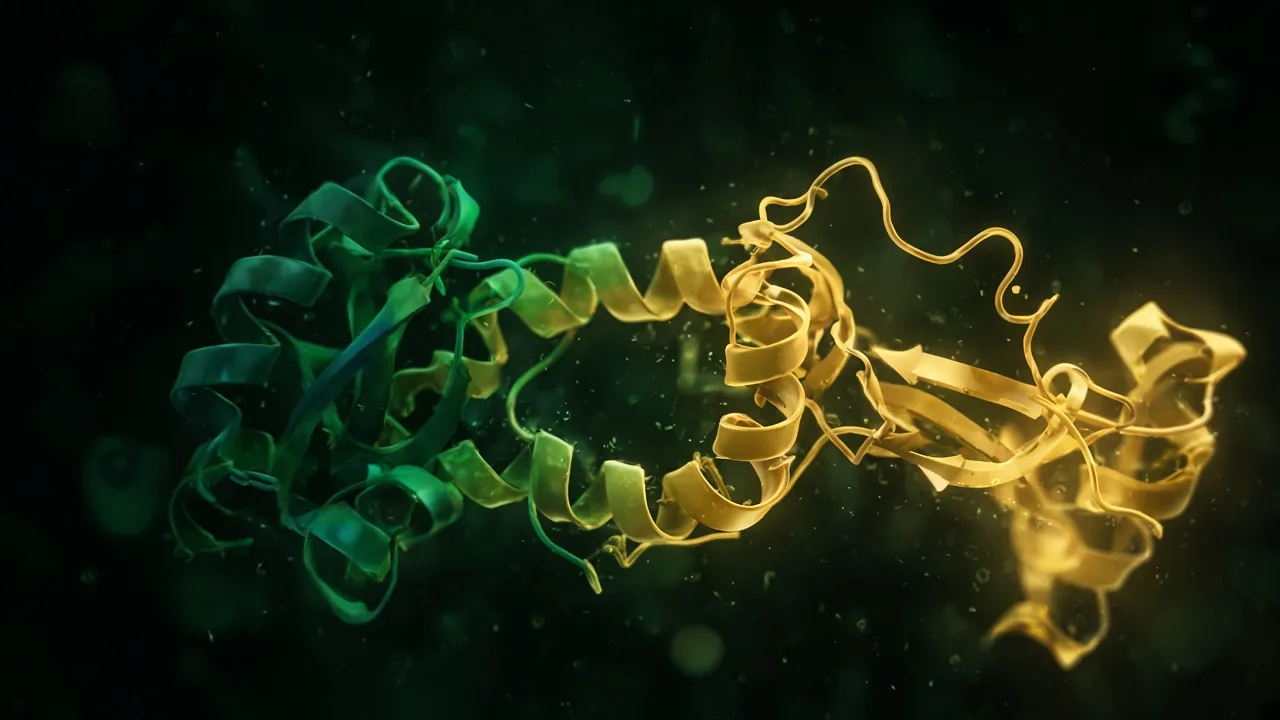
How AI Cracked Protein Folding — And Walked Away With a Nobel
Protein structure prediction went from grand challenge to infrastructure. The Nobel recognition made it official: AI is not only a tech story. It is a science story with medicine downstream.
Contents
- The stake
- Full walkthrough, step by step
- What sophisticated operators notice
- Background and context
- Why this matters
- Practical playbook
- Risks and counterpoints
- FAQ
- The bottom line
The stake
Some AI stories are feature tours. How AI Cracked Protein Folding — And Walked Away With a Nobel is more useful as an operating narrative: what you set up, what you grant, what gets built, what breaks, and what a careful team should copy.
Ideas work changes funding and fear. Separate falsifiable claims from metaphors, then ask what experiment would change your mind.
This long read unpacks the full arc without channel plugs or personality worship. It keeps the gripping parts — curiosity gaps, concrete demos, sharp numbers — and adds the adult layers demos skip: controls, metrics, counterpoints, and an FAQ aimed at searches people make the next morning.
Full walkthrough, step by step
The walkthrough only pays off if you can restage it. The sections below follow the source material’s order while rewriting every beat in original language.
Pass 1: orientation and promise
This portion of the walkthrough is where orientation and promise gets real. Instead of a vibe summary, treat it as a checkpoint: what must already be true before this stage works, what gets created here, and what evidence you should keep.
Quantitative claims mentioned along the way include 14, 2024, 3.7, 20, 1969,. Copy them into a verification column. Confirm against primary documentation or your own meter before they become budget assumptions.
A practical reading method: pause at every moment a human has to paste a secret, approve a spend, or interpret a UI the agent cannot see reliably. Those moments are your real control plane. Automate around them; do not pretend they disappeared.
When this pass ends, you should be able to answer three questions without replaying anything: what artifact exists now, what permission was granted, and what would break if the network dropped for ten minutes.
Pass 2: environment setup
This portion of the walkthrough is where environment setup gets real. Instead of a vibe summary, treat it as a checkpoint: what must already be true before this stage works, what gets created here, and what evidence you should keep.
Quantitative claims mentioned along the way include 3, 1957,, 1970, 200,000, 1960. Copy them into a verification column. Confirm against primary documentation or your own meter before they become budget assumptions.
A practical reading method: pause at every moment a human has to paste a secret, approve a spend, or interpret a UI the agent cannot see reliably. Those moments are your real control plane. Automate around them; do not pretend they disappeared.
When this pass ends, you should be able to answer three questions without replaying anything: what artifact exists now, what permission was granted, and what would break if the network dropped for ten minutes.
Pass 3: core configuration
This portion of the walkthrough is where core configuration gets real. Instead of a vibe summary, treat it as a checkpoint: what must already be true before this stage works, what gets created here, and what evidence you should keep.
Quantitative claims mentioned along the way include 20, 1990, 100. Copy them into a verification column. Confirm against primary documentation or your own meter before they become budget assumptions.
A practical reading method: pause at every moment a human has to paste a secret, approve a spend, or interpret a UI the agent cannot see reliably. Those moments are your real control plane. Automate around them; do not pretend they disappeared.
When this pass ends, you should be able to answer three questions without replaying anything: what artifact exists now, what permission was granted, and what would break if the network dropped for ten minutes.
Pass 4: primary workflow
This portion of the walkthrough is where primary workflow gets real. Instead of a vibe summary, treat it as a checkpoint: what must already be true before this stage works, what gets created here, and what evidence you should keep.
Quantitative claims mentioned along the way include 0, 100, 90, 1994,, 10 years, 1, 2002,. Copy them into a verification column. Confirm against primary documentation or your own meter before they become budget assumptions.
A practical reading method: pause at every moment a human has to paste a secret, approve a spend, or interpret a UI the agent cannot see reliably. Those moments are your real control plane. Automate around them; do not pretend they disappeared.
When this pass ends, you should be able to answer three questions without replaying anything: what artifact exists now, what permission was granted, and what would break if the network dropped for ten minutes.
Pass 5: orchestration and handoffs
This portion of the walkthrough is where orchestration and handoffs gets real. Instead of a vibe summary, treat it as a checkpoint: what must already be true before this stage works, what gets created here, and what evidence you should keep.
Operational themes that dominate this stretch: SMS workflow, training loop. If you are rebuilding the path yourself, make each of those a labeled step in your own checklist with a owner and a rollback.
Named surfaces that appear here include AlphaFold. Those are not interchangeable logos — each one implies login state, rate limits, and a failure mode. Write down which identity the agent uses on each surface.
Quantitative claims mentioned along the way include 2017,, 1, 136,000, 2018,, 13, 2,. Copy them into a verification column. Confirm against primary documentation or your own meter before they become budget assumptions.
A practical reading method: pause at every moment a human has to paste a secret, approve a spend, or interpret a UI the agent cannot see reliably. Those moments are your real control plane. Automate around them; do not pretend they disappeared.
When this pass ends, you should be able to answer three questions without replaying anything: what artifact exists now, what permission was granted, and what would break if the network dropped for ten minutes.
Pass 6: live demonstration
This portion of the walkthrough is where live demonstration gets real. Instead of a vibe summary, treat it as a checkpoint: what must already be true before this stage works, what gets created here, and what evidence you should keep.
Operational themes that dominate this stretch: SMS workflow, training loop, quantization. If you are rebuilding the path yourself, make each of those a labeled step in your own checklist with a owner and a rollback.
Named surfaces that appear here include AlphaFold. Those are not interchangeable logos — each one implies login state, rate limits, and a failure mode. Write down which identity the agent uses on each surface.
Quantitative claims mentioned along the way include 3, 14, 2020, 2, 90, 14,. Copy them into a verification column. Confirm against primary documentation or your own meter before they become budget assumptions.
A practical reading method: pause at every moment a human has to paste a secret, approve a spend, or interpret a UI the agent cannot see reliably. Those moments are your real control plane. Automate around them; do not pretend they disappeared.
When this pass ends, you should be able to answer three questions without replaying anything: what artifact exists now, what permission was granted, and what would break if the network dropped for ten minutes.
Pass 7: results and verification
This portion of the walkthrough is where results and verification gets real. Instead of a vibe summary, treat it as a checkpoint: what must already be true before this stage works, what gets created here, and what evidence you should keep.
Named surfaces that appear here include AlphaFold. Those are not interchangeable logos — each one implies login state, rate limits, and a failure mode. Write down which identity the agent uses on each surface.
Quantitative claims mentioned along the way include 2022,, 218, 2, 3, 2,. Copy them into a verification column. Confirm against primary documentation or your own meter before they become budget assumptions.
A practical reading method: pause at every moment a human has to paste a secret, approve a spend, or interpret a UI the agent cannot see reliably. Those moments are your real control plane. Automate around them; do not pretend they disappeared.
When this pass ends, you should be able to answer three questions without replaying anything: what artifact exists now, what permission was granted, and what would break if the network dropped for ten minutes.
Pass 8: implications and next moves
This portion of the walkthrough is where implications and next moves gets real. Instead of a vibe summary, treat it as a checkpoint: what must already be true before this stage works, what gets created here, and what evidence you should keep.
Named surfaces that appear here include AlphaFold. Those are not interchangeable logos — each one implies login state, rate limits, and a failure mode. Write down which identity the agent uses on each surface.
Quantitative claims mentioned along the way include 2024, 3, 2020, 2024,. Copy them into a verification column. Confirm against primary documentation or your own meter before they become budget assumptions.
A practical reading method: pause at every moment a human has to paste a secret, approve a spend, or interpret a UI the agent cannot see reliably. Those moments are your real control plane. Automate around them; do not pretend they disappeared.
When this pass ends, you should be able to answer three questions without replaying anything: what artifact exists now, what permission was granted, and what would break if the network dropped for ten minutes.
Beyond the checklist, write a one-page "threat and failure board" for this workflow: top ways it can be wrong, top ways it can be abused, and the alert you would want within an hour. Keep that board next to the SOP. Teams that only document happy paths recreate the demo's blind spot.
If you collaborate, add a short table with columns for step, owner, system touched, secret required, and rollback. That single table prevents most "I thought you had the key" outages.
What sophisticated operators notice
Amateurs chase the climax demo. Operators watch the boring connective tissue: where secrets enter the system, how identities are scoped, whether tasks can restart after a crash, and whether outputs are evaluated against a written definition of done.
They also notice narrative cheats — cuts that hide twenty minutes of babysitting, 'authorized engagement' prompts that paper over policy risk, and success metrics that count activity instead of outcomes.
If you adopt only one habit from this article, adopt receipt-keeping: timestamped logs, screenshots, outputs, and a short postmortem note every time the agent surprises you.
Background and context
Through 2025–2026, always-on agents, computer use, and multi-agent handoff moved from research demos into consumer-shaped products. That is why tutorials that once felt niche now read like literacy.
Evaluate any stack on four axes: persistence (does work survive a closed laptop), identity (whose accounts, whose keys), provenance (who signed the skills/plugins), and observability (can you see tool calls and reverse a bad action).
In the big-ideas lane specifically: Ideas work changes funding and fear. Separate falsifiable claims from metaphors, then ask what experiment would change your mind.
Worked example
Imagine you only have ninety minutes this week. Do not replay the entire cinematic path. Pick the smallest slice that still teaches the control plane:
- Stand up an isolated profile with no production keys.
- Run one supervised task that produces a tangible artifact.
- Force one failure on purpose (revoke a token mid-run).
- Confirm your logging shows the failure clearly.
- Write a five-line postmortem and a revised checklist.
That ninety-minute drill teaches more than three passive rewatches. It also creates the cultural muscle of expecting failure instead of being shocked by it.
If the slice succeeds cleanly, schedule a harder slice next week — more tools, one irreversible action behind an approval gate, and a second human as reviewer. Increase difficulty only when the previous slice is boring.
Why this matters
Capability is getting cheaper faster than organizations are rewriting their control maps. That mismatch is where incidents come from.
Builders should encode process before scaling agents. Defenders should assume phone-steered cloud agents exist. Operators should measure cycle time and rework. Leaders should budget human review — speed without taste is just faster sludge.
Practical playbook
Before
- One-sentence goal + definition of done
- Disposable environment / non-personal profile
- Explicit allowlist of tools and destinations
During
- Split exploration vs production threads
- Approvals on spend, send, and production writes
- Capture receipts continuously
After
- Convert the win into a checklist/skill
- Adversarial retest (expired session, denied permission, partial outage)
- Weekly credential and automation audit
Scoreboard
- Time-to-done on a recurring chore
- Human babysitting minutes
- Rework after 'done'
- Incidents tied to agent actions
Risks and counterpoints
Demos hide babysitting. Captchas, codes, refusals, and flaky selectors still interrupt autonomy.
Legal and policy risk remains human: unauthorized access and abusive messaging are not excused by software.
Shared agent computers are shared keychains. Fluent wrong answers merge fast if review disappears.
Maximal automation is the wrong god. Some work should stay slow because silent failure costs more than the hours you might save.
FAQ
What is the first move after reading “How AI Cracked Protein Folding — And Walked Away With a Nobel”?
Restage one thin slice in a disposable environment with read-only defaults. Expand only after that slice is boringly reliable.
Do I need a top-tier model?
Not always. Use a strong model for planning and hard reasoning; cheaper models for grunt work. Harness and permissions beat raw bench score for most ops.
How do I keep company data safe?
Isolated accounts, least privilege, logging, DLP-aware destinations, and a written policy for what may leave the environment.
Why do runs work once then fail?
UI drift, expired sessions, rate limits, and hidden dependencies. Stabilize with checklists and fewer moving parts.
How is this different from chatbots?
Agents persist, use tools, and change system state. That power is the point — and the reason controls are not optional.
Field checklist addendum 1
Write the shutdown command before the launch command. Decide who can freeze the agent, how credentials get rotated, and where anomalies are posted. Add a monthly cleanup: revoke unused tokens, delete dead skills, close stale browser sessions, archive old Kanban cards, and re-verify that logging still works.
If multiple people can steer the same agent, require dual control on high-impact actions the same way finance requires dual control on wires. Social protocol is part of the security model whether or not your vendor UI admits it.
Field checklist addendum 2
Write the shutdown command before the launch command. Decide who can freeze the agent, how credentials get rotated, and where anomalies are posted. Add a monthly cleanup: revoke unused tokens, delete dead skills, close stale browser sessions, archive old Kanban cards, and re-verify that logging still works.
If multiple people can steer the same agent, require dual control on high-impact actions the same way finance requires dual control on wires. Social protocol is part of the security model whether or not your vendor UI admits it.
Field checklist addendum 3
Write the shutdown command before the launch command. Decide who can freeze the agent, how credentials get rotated, and where anomalies are posted. Add a monthly cleanup: revoke unused tokens, delete dead skills, close stale browser sessions, archive old Kanban cards, and re-verify that logging still works.
If multiple people can steer the same agent, require dual control on high-impact actions the same way finance requires dual control on wires. Social protocol is part of the security model whether or not your vendor UI admits it.
Field checklist addendum 4
Write the shutdown command before the launch command. Decide who can freeze the agent, how credentials get rotated, and where anomalies are posted. Add a monthly cleanup: revoke unused tokens, delete dead skills, close stale browser sessions, archive old Kanban cards, and re-verify that logging still works.
If multiple people can steer the same agent, require dual control on high-impact actions the same way finance requires dual control on wires. Social protocol is part of the security model whether or not your vendor UI admits it.
The bottom line
Steal the loop from “How AI Cracked Protein Folding — And Walked Away With a Nobel”, not the mythology: clear goal, constrained tools, visible state, approvals on irreversible steps, receipts afterward. Do that and capable models become leverage. Skip it and they become eloquent accelerants for the same old mess.
Sources
- NIST, AI Risk Management Framework
- OWASP, Top 10 and AI security resources
- Anthropic, Claude documentation
- OpenAI, Platform docs
- Google DeepMind, research updates

More stories you'll want to read
AI + physics12 minAt Davos, physicists from MIT, EPFL, Kyoto and Tokyo argued that AI is not only a tool for physics — it is a physical system we can finally study with the same math we use for gases and gravity.Read now →
 Living minds12 minBiologist Michael Levin argues intelligence shows up in cells and tissues long before brains — and that AI may already be growing goals in the gaps of its code.Read now →
 Hinton12 minIn a long conversation on StarTalk, Geoffrey Hinton warned that today’s systems may already be more capable than their polite chat interfaces suggest — and that evolution never prepared us for digital minds that copy instantly.Read now →
 AI talent12 minInternet lists love crowning a single AI genius. The healthier read is a map of different talents — research taste, systems genius, product instinct, capital allocation — that do not fit in one body.Read now →
 AI power12 minA Four Corners-style documentary question keeps returning: who steers AI — labs, states, capital, or the public? The honest answer is a messy tug-of-war with uneven seats at the table.Read now →
 AI careers12 minLong-form conversations with AI engineers at frontier companies keep revealing the same shift: software careers now reward people who can wire models into physical and operational systems, not only CRUD apps.Read now →