 AI hackers4 minGoogle’s Big Sleep agent caught a real SQLite flaw before release, and DARPA’s AI Cyber Challenge finalists found 18 real bugs in open-source code. What autonomous security agents can do, and why it cuts both ways.Read now →
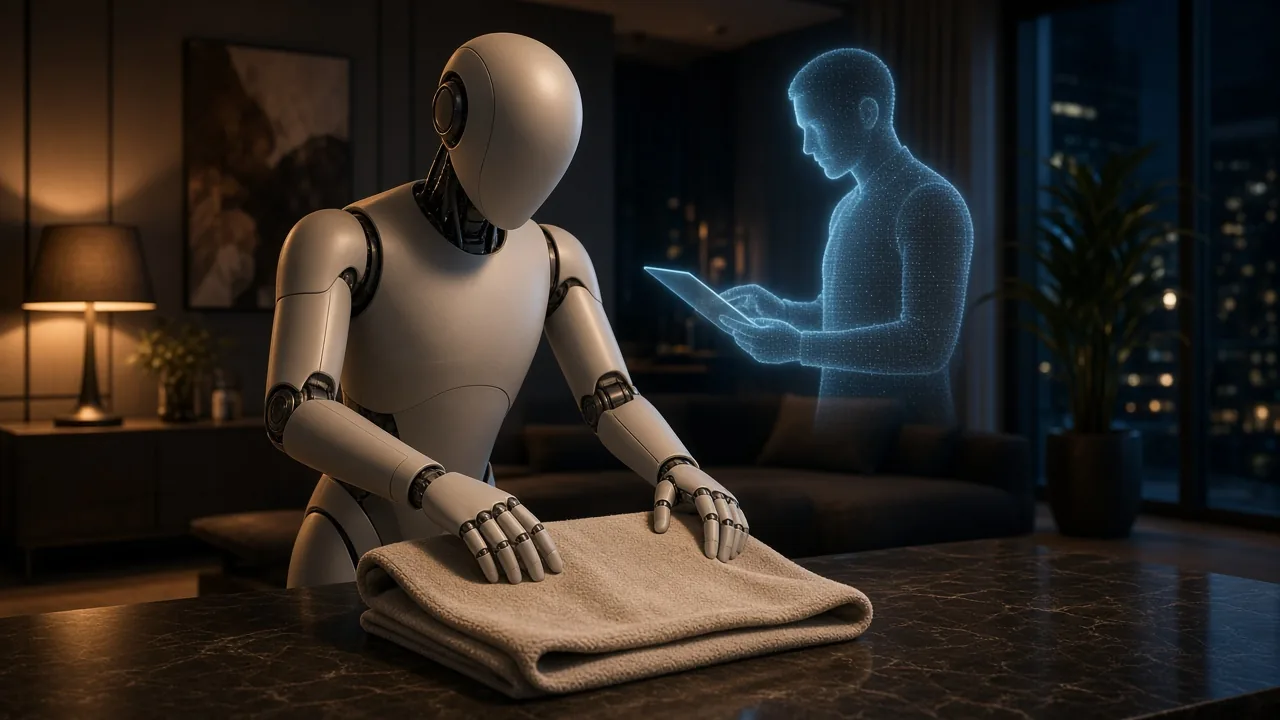
A $20,000 Humanoid Robot Is Taking Preorders for Your Home. Read the Fine Print First
1X’s NEO is one of the first humanoid robots sold to consumers, with deliveries slated for 2026. Here is what it promises, how the teleoperation catch works, and where the humanoid race really stands.
Advertisement
AdSense slot · articleTopplaceholder until ca-pub ID is set
For decades, the household humanoid robot has been a sci-fi staple that was always ten years away. On October 28, 2025, a company called 1X tried to make it a product you can order online.
1X, a robotics startup based in Palo Alto, announced NEO, a humanoid robot designed for chores at home, and opened preorders. “Humanoids were long a thing of sci-fi... then they were a thing of research, but today — with the launch of NEO — humanoid robots become a product,” CEO Bernt Børnich said in the announcement.
It is a genuine milestone. It also comes with fine print that anyone tempted to put down a deposit should read carefully.
The offer
According to 1X’s order page and launch announcement:
Advertisement
AdSense slot · articleMidplaceholder until ca-pub ID is set
- Early Access ownership costs $20,000, with priority delivery in 2026, a three-year warranty and premium support.
- A subscription option costs $499 per month, shipping later. Fast Company reported a six-month minimum.
- A $200 fully refundable deposit reserves a unit.
- Deliveries were planned primarily in the U.S. in 2026, with other markets starting in 2027.
- NEO comes in three colors: tan, gray and dark brown.
The catch: a human may be driving
Here is the part that matters most. As Engadget reported, NEO was set to ship able to do some basic tasks on its own, like opening doors, fetching items and turning lights on and off. For more specific or complex chores, owners would need to be comfortable with a human teleoperator controlling the robot remotely, and seeing inside their home through its cameras.
That is not a scandal; it is how 1X plans to train the robot. Remote human operation generates the real-world data needed to teach the AI to do those chores autonomously over time. But it reframes the purchase. Early buyers are not just getting a robot butler. They are, in part, paying to help train one.
Before buying any home robot that works this way, ask:
- When can a remote operator see or control it, and do you get a clear notice and an off switch?
- Who are the operators, and how are they vetted?
- What video and audio is stored, where, for how long, and is it used for training?
- Which tasks are truly autonomous on delivery day, rather than promised later?
Where the wider humanoid race stands
1X is not alone. A wave of companies is racing to make humanoids useful, mostly starting in factories and warehouses, where tasks are repetitive and environments are controlled.
- Boston Dynamics retired its hydraulic Atlas in April 2024 and unveiled a fully electric Atlas aimed at commercial work, with its parent company Hyundai as an early testbed.
- Figure AI announced a commercial agreement with BMW in January 2024 to bring humanoids to BMW’s plant in Spartanburg, South Carolina.
- Unitree, a Chinese robotics maker, announced its G1 humanoid in May 2024 with a starting price of $16,000, dramatically lower than most competitors and popular with researchers.
- Tesla has repeatedly showcased its Optimus robot and says it intends to use it in its own factories first.
The common thread: the hardware has improved quickly, and AI models that can see, understand instructions and plan actions are finally good enough to make general-purpose robots plausible. The hard part is reliability in messy, unpredictable environments, and few places are messier than a family home.
Why homes are the hardest test
A factory can be redesigned around a robot. A home cannot. Kids, pets, stairs, clutter, fragile objects, different layouts in every house, and tasks that change every day all make domestic robotics brutally difficult. Safety is non-negotiable when a heavy machine shares space with people.
That is why most companies are going to homes last, and why 1X’s approach of starting with a lightweight, soft-bodied design and a human in the loop is a deliberate strategy rather than a shortcut.
Should you buy one?
For most people, not yet. If you are an enthusiast with the budget, comfortable with remote operation, and excited to be part of an early experiment, Early Access is a chance to own a piece of history. If you want a reliable appliance that saves you hours of chores from day one, wait for independent reviews of shipped units and real-world autonomy, not demo videos.
The bottom line
NEO marks the moment humanoid robots crossed from research labs into a consumer checkout page. That is a big deal. But the price tag buys a robot that, for many tasks, may still rely on a remote human while it learns. Read the privacy terms as closely as the spec sheet, and treat any household humanoid in this first wave as a pioneer product, with all the excitement and rough edges that implies.
Sources
- 1X, “NEO Home Robot” launch announcement, Oct. 28, 2025
- 1X, Order NEO
- Engadget, “1X Neo is a $20,000 home robot that will learn chores via teleoperation”, Oct. 29, 2025
- Fast Company, “Meet the humanoid robot headed for homes”, Oct. 28, 2025
- Boston Dynamics, “An electric new era for Atlas”, Apr. 2024
- Figure AI via PR Newswire, “Figure announces commercial agreement with BMW Manufacturing”, Jan. 2024

More stories you'll want to read
AI hackers4 minGoogle’s Big Sleep agent caught a real SQLite flaw before release, and DARPA’s AI Cyber Challenge finalists found 18 real bugs in open-source code. What autonomous security agents can do, and why it cuts both ways.Read now →
 AI water use5 minOne side says every chatbot reply drinks a bottle of water. The other says it is five drops. Both are quoting real studies. Here is what each number actually measures, and the part of the debate that really matters.Read now →
 AI ran a shop5 minEveryone wants an AI agent that runs a business on autopilot. Anthropic actually tried it with a real office store. What went wrong is the best free lesson in agent-run businesses you will find.Read now →
 It uses your PC5 minComputer-use agents click, type and scroll like a person. They are genuinely useful for some jobs and dangerously unreliable for others. Here is how to tell the difference.Read now →
 The 7-month rule4 minResearchers at METR found a simple way to measure AI progress, and the answer is a doubling curve. Here is what it measures, why it matters, and the caveats nobody puts in the thumbnail.Read now →
 19% slower?!4 minA randomized trial with experienced open-source developers found AI tools slowed them down, even as they felt sped up. Here is what the study really shows and how to avoid the trap.Read now →