 AI hackers4 minGoogle’s Big Sleep agent caught a real SQLite flaw before release, and DARPA’s AI Cyber Challenge finalists found 18 real bugs in open-source code. What autonomous security agents can do, and why it cuts both ways.Read now →
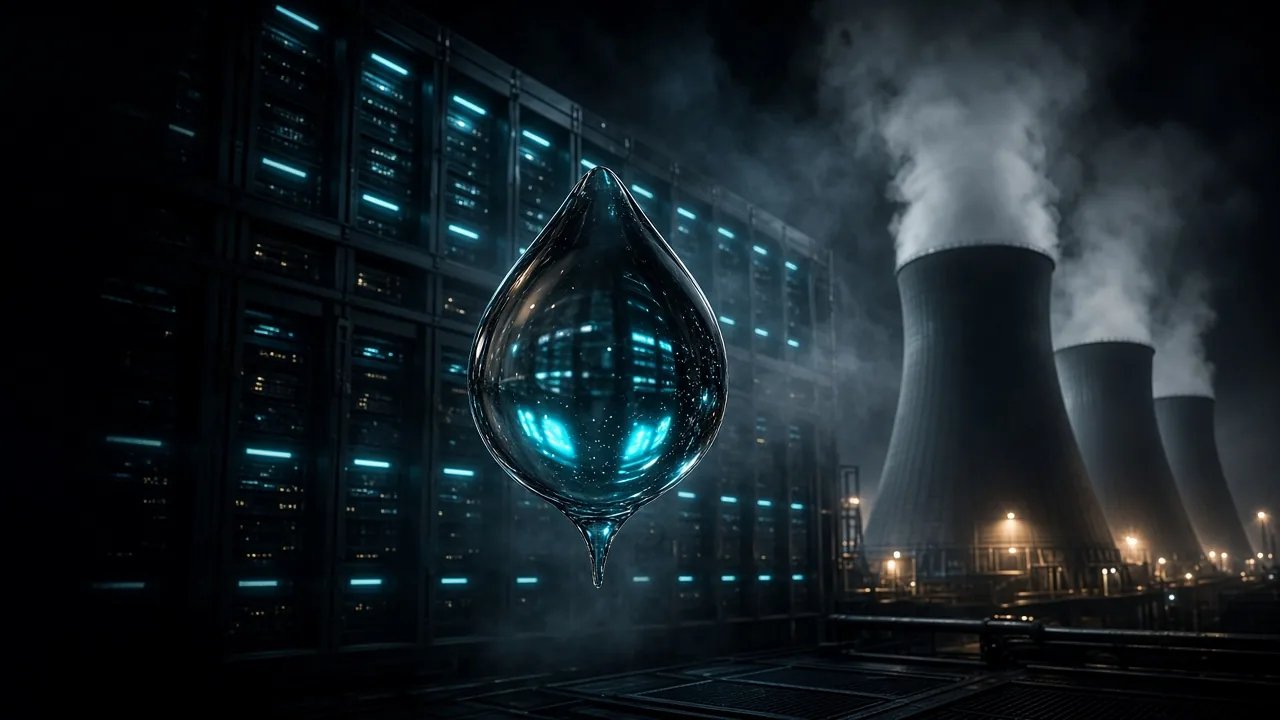
Why Is Everyone So Wrong About AI Water Use? The Real Numbers Behind the Panic
One side says every chatbot reply drinks a bottle of water. The other says it is five drops. Both are quoting real studies. Here is what each number actually measures, and the part of the debate that really matters.
Advertisement
AdSense slot · articleTopplaceholder until ca-pub ID is set
Few AI arguments get as heated, or as confused, as water. Scroll social media and you will see claims that every ChatGPT conversation “drinks a bottle of water,” followed by replies insisting a prompt uses “a few drops.” Both camps are quoting real research. They are just measuring different things.
Here is how to make sense of it.
Why data centers use water at all
Computers turn electricity into heat. Data centers packed with AI chips produce a lot of it, and one of the most efficient ways to remove that heat is evaporative cooling, which consumes water. There is also an indirect water cost: many power plants use water for cooling and steam, so the electricity a data center draws carries a water footprint of its own.
Keep those two buckets in mind, direct water used on site and indirect water used to generate the electricity, because most of the disagreement comes from which one is counted.
Advertisement
AdSense slot · articleMidplaceholder until ca-pub ID is set
The “bottle of water” number
The scary estimate traces back to a 2023 study by researchers at UC Riverside and UT Arlington, “Making AI Less ‘Thirsty’”. Using public data and modeling, they estimated that GPT-3-class models could consume roughly a 500 ml bottle of water for a batch of 10 to 50 medium-length responses, depending on when and where the model runs. They also estimated that training GPT-3 in Microsoft’s U.S. data centers could have directly evaporated around 700,000 liters of fresh water.
Importantly, that estimate included both on-site cooling water and the water used to generate electricity, and it was an outside estimate for an older model, not a measurement from inside a provider.
The “five drops” number
In August 2025, Google published the first detailed measurement from inside a major AI provider. In a technical paper and blog post, it estimated that the median Gemini Apps text prompt in May 2025 used:
- 0.24 watt-hours of energy, less than watching about nine seconds of TV
- 0.26 milliliters of water, about five drops
- 0.03 grams of CO2-equivalent emissions
Google also reported a 33x reduction in energy per median prompt over one year, thanks to software and hardware efficiency gains.
OpenAI CEO Sam Altman offered a similar order of magnitude in a June 2025 blog post, “The Gentle Singularity,” saying the average ChatGPT query uses about 0.34 watt-hours and about 0.000085 gallons of water, roughly one fifteenth of a teaspoon. He did not publish a detailed methodology.
So who is right?
Both numbers can be true at once, because they measure different things:
- Different scope. As The Verge reported, experts criticized Google’s figure for leaving out indirect water from electricity generation, which can be the majority of a data center’s water footprint.
- Median vs. everything. Google’s number is for the median text prompt. Long reasoning chains, image generation, video generation and agents running for minutes can use far more.
- Different years and hardware. The 2023 estimate modeled an older model on older infrastructure. Efficiency has improved a lot since.
- Self-reported vs. independent. Google noted its figures had not been verified by an independent third party.
The fair summary: a single typical text prompt is small, smaller than many viral claims suggest. But “per prompt” is not the right frame for the real debate.
The part that actually matters: scale and location
The real issue is not your chat. It is billions of chats, plus training runs, plus everything else data centers do, concentrated in specific places.
The International Energy Agency’s 2025 Energy and AI report estimated that data centers used about 415 terawatt-hours of electricity in 2024, around 1.5% of global electricity. In its base case, that more than doubles to about 945 TWh by 2030, slightly more than Japan’s entire electricity consumption today, with AI as the biggest driver.
Globally, that is still a small share. Locally, it can be huge. The IEA notes that data centers are geographically concentrated, and a large facility can draw as much power as a heavy industrial plant. A data center using evaporative cooling in a drought-stressed region is a very different story from one cooled with recycled water in a wet climate.
How to talk about AI water use without getting dunked on
- Don’t say one prompt drinks a bottle. That is not what the original research claimed for a single reply, and newer measurements are far lower.
- Don’t say it is nothing either. Totals are growing fast, indirect water is often left out, and local impacts are real.
- Ask “where?” The same data center can be harmless or harmful depending on local water stress and cooling design.
- Ask “what counts?” Direct only, or direct plus electricity? Median text prompt, or video and agents too?
- Push for transparency. The best outcome of this fight is more providers publishing audited, comparable numbers.
The bottom line
The viral arguments are wrong in both directions. A single text prompt uses a small amount of water, and it has gotten much more efficient. But AI’s total energy and water demand is growing quickly and lands hard in specific communities. The honest debate isn’t about drops versus bottles. It is about where the next wave of data centers gets built, and what powers and cools them.
Sources
- Li et al., “Making AI Less ‘Thirsty’: Uncovering and Addressing the Secret Water Footprint of AI Models” (arXiv:2304.03271)
- Google Cloud, “Measuring the environmental impact of AI inference”, Aug. 21, 2025
- Google, “Measuring the environmental impact of delivering AI at Google Scale” (arXiv:2508.15734)
- Sam Altman, “The Gentle Singularity”, June 2025
- The Verge, “Google says a typical AI text prompt only uses 5 drops of water — experts say that’s misleading”, Aug. 2025
- International Energy Agency, Energy and AI: Energy demand from AI, 2025

More stories you'll want to read
AI hackers4 minGoogle’s Big Sleep agent caught a real SQLite flaw before release, and DARPA’s AI Cyber Challenge finalists found 18 real bugs in open-source code. What autonomous security agents can do, and why it cuts both ways.Read now →
 It uses your PC5 minComputer-use agents click, type and scroll like a person. They are genuinely useful for some jobs and dangerously unreliable for others. Here is how to tell the difference.Read now →
 The 7-month rule4 minResearchers at METR found a simple way to measure AI progress, and the answer is a doubling curve. Here is what it measures, why it matters, and the caveats nobody puts in the thumbnail.Read now →
 19% slower?!4 minA randomized trial with experienced open-source developers found AI tools slowed them down, even as they felt sped up. Here is what the study really shows and how to avoid the trap.Read now →
 Vibe coding4 minAndrej Karpathy coined it in February 2025. By November, Collins Dictionary crowned it. Vibe coding lets anyone build software by describing it, and it comes with very specific traps.Read now →
 $589B gone4 minIn January 2025 a Chinese lab called DeepSeek released a reasoning model that rivaled the best in the world, and Wall Street panicked. Here is what the famous price tag really covered, and what the market got wrong.Read now →