 7 tests for a mind15 minFrom Turing's imitation game to planting thoughts inside a model's network, researchers have spent decades designing ways to detect consciousness from the outside. AI is now taking those tests. It passes some, half-passes others, and one test nobody, human or machine, has ever passed. The full scorecard.Read now →
An AI Now Watches the Tracks for Elephants. Here Are 12 Places AI Is Quietly Saving Lives
The same kind of AI that writes your emails is braking trains for elephants, catching tsunamis from space, giving an ALS patient his voice back and designing antivenom molecules. Here are 12 real projects, what they've achieved, the honest limits of each, and the one thing they all have in common.
Advertisement
Most AI headlines are about money, jobs or chatbots behaving badly.
Meanwhile, in places most people never hear about, the same technology is doing something else entirely.
In southern India, cameras along a railway line spot elephants in the dark and warn train drivers in time. In California, a man silenced by ALS speaks again, in his own voice. In Peru's desert, ancient drawings nobody had seen for centuries are coming to light.
None of these tools were exotic inventions. Many run on the same kind of AI that writes your emails and picks your ads. A few people simply pointed it at something bigger.
Advertisement
Here are 12 of those projects, counted down. Each comes with what it achieved and, just as important, what it hasn't.
12. A language no tech giant could understand
At the far edge of New Zealand, a small Māori radio station and media charity, Te Hiku Media, set out to build something no big tech company had: speech recognition that genuinely understands spoken te reo Māori.
To learn a language, a machine has to hear it for hours and hours. So the organization asked its own community. In a 10-day campaign, people read Māori sentences into their phones, enough recorded speech to train a working model.
Then came the test. A global data company wanted recordings like these and offered to pay. The station said no.
Its CEO, Peter-Lucas Jones, explained the refusal in terms of sovereignty: as a Māori charity, they know what it means to lose control of something precious. In his framing, data is the new land.
The limit: a machine can't keep a language alive. Only speakers can. But this time, the speakers own the machine.
11. The AI that wastes time on purpose
In Australia, an AI was built to be slow.
Not with your time. With a phone scammer's.
A researcher there once kept a scammer on the line for about 40 minutes during a family picnic. All that time, the scammer wasn't robbing anyone else. That insight became a company that does it all day with AI "victims": chatty, convincing synthetic personas with all the time in the world.
One of Australia's big phone networks already routes scam calls straight to these bots. Every minute a scammer spends talking to a machine is a minute not spent on a vulnerable person.
The limit: it reduces scammers' capacity rather than stopping scams. And scammers are adopting AI too.
Here, the AI wins by being slow. Over Wyoming, it has to be fast.
10. Eagles and wind turbines
Wind turbines make clean power. They also kill eagles.
Stop every turbine and you lose the power. Stop none and the eagles die. What would you do?
On one wind farm in Wyoming, camera towers watch the sky. In a fraction of a second, an AI system decides: eagle or not? If an eagle is on a collision course, only the turbines in its path slow down.
A peer-reviewed study credited the system with cutting eagle deaths at that site by more than four in five.
The limit: other scientists caution that results from a single wind farm can't yet prove the effect everywhere. Here, one miss costs an eagle, so the evidence bar is high.
9. The desert drawings nobody saw
Peru's Nazca desert is famous for its giant ancient drawings, the geoglyphs best seen from the air.
A research team led from Japan's Yamagata University, working with IBM, used an AI model to comb high-resolution aerial photos. The AI flagged tens of thousands of candidate spots. Almost all of them were nothing.
That turned out not to matter. Archaeologists checked only the most promising leads on foot and, within months, found 303 new figurative geoglyphs, nearly doubling the number known.
The new ones are mostly small, and they sit close to ancient footpaths. The team's interpretation: the giant line drawings were made for community rituals, while the small figures were meant for people walking past.
The lesson: the AI didn't need to be right. It only had to tell people where to look.
But what happens when the machine points, and nobody looks?
8. Methane, seen from space
Methane is invisible, and over the short term it heats the planet far faster than carbon dioxide. Catching every leak would require eyes over the entire planet.
Those eyes already exist. Satellites built to watch fields and forests can pick up methane's faint shadow. Under the UN Environment Programme's Methane Alert and Response System (MARS), automated analysis searches satellite imagery for major plumes. Experts verify them, and the UN notifies the government responsible.
In Algeria, one leak at a gas facility had been visible from space for more than a decade. Months after the alerts, operators fixed a valve and the plume stopped. UNEP recorded it as a confirmed mitigation.
The limit, and it's a big one: that's the exception. UNEP's 2025 report says response rates climbed from about 1% to more than 12%, which means nearly nine in ten alerts still get no answer.
Seeing isn't saving.
7. The man who speaks again
Casey Harrell knows exactly what he wants to say. His brain still sends the words. His lips no longer follow. He has ALS, and he described the experience as being trapped.
How do you hear a sentence that never leaves the body?
At UC Davis, surgeons placed tiny sensor arrays in the part of his brain that controls his lips, tongue and jaw. An AI learned which patterns of neural signals correspond to which speech sounds. It doesn't read his thoughts, only the words he's trying to say.
Then it speaks them, in his own voice, rebuilt from recordings made before he fell ill. In the research team's published results, the system decoded his attempted speech with very high accuracy within days of setup. According to the project, at home he went on to speak almost 2 million words with it in under two years.
For people who can't communicate well or quickly, isolation is one of the cruelest parts of illness. A tool like this offers hope and the chance to be more fully themselves.
The limit: it's one man in a research study. It's not a treatment anyone can get yet, and it requires brain surgery.
6. Ships that vanish from the map
Large ships are supposed to broadcast their position on a radio system built so they don't collide.
Take a guess: how many industrial fishing boats stay off the public map?
Researchers with Global Fishing Watch used AI to compare years of satellite radar imagery with those broadcasts. Their answer, published in Nature: about three in four industrial fishing vessels aren't publicly tracked.
Going "dark" doesn't automatically mean illegal. But it's where the worst activity can hide, from illegal fishing to labor abuse. Another AI approach reads how ships move and flags vessels whose crews may not be free to go home.
The limit: that's a risk score, not a verdict. Humans and authorities still have to investigate.
A ship can hide by switching its radio off. A tsunami hides in plain sight.
5. A tsunami in the sky
In the open ocean, a tsunami is barely a ripple. How do you see it coming before it reaches land?
Look up.
The rising water shoves the air above it. That push travels all the way to the upper atmosphere, where it disturbs the electrically charged ionosphere and makes GPS signals arrive a tiny bit late. The same signals your phone uses for directions now carry a clue.
NASA's Jet Propulsion Laboratory built GUARDIAN, which monitors those disturbances in near real time, and added an AI component that automatically searches for tsunami signatures after big earthquakes. It was switched on shortly before the magnitude 8.8 Kamchatka earthquake on July 29, 2025.
NASA's replay shows the system flagging tsunami-related signals in the sky over Hawaii about 30 minutes before the first tide gauge there recorded the wave.
The limit: it's still a research tool, not an official warning system. But half an hour can warn a whole coast.
You can't warn an elephant, though.
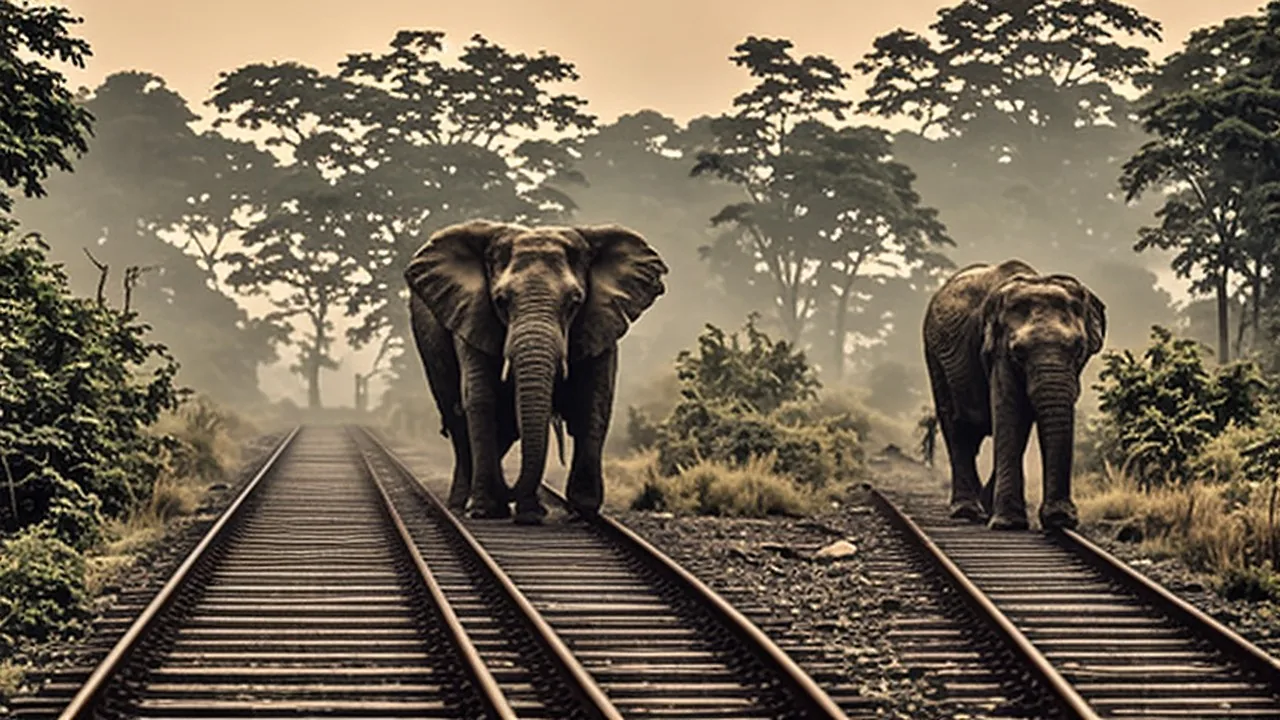
4. The train that brakes for elephants
Imagine driving a train at night through an elephant corridor in southern India. By the time your headlights catch an elephant on the track, it's too late to stop.
Unless the track sees it first.
In Tamil Nadu, towers along a stretch of railway carry thermal cameras that see heat in the dark. An AI recognizes elephants and sends alerts to the train driver and forest rangers.
This time, unlike so many methane alerts, the warning gets an answer: trains slow down on the monitored stretch. Officials say no train has killed an elephant there since the system went live.
The limit: it covers specific stretches of track, not every corridor. Scaling it takes money and coordination.
Elephants are the giants here. But across India, a much smaller animal kills about 100 times more people. It hides in the grass.
3. Designing an antivenom from scratch
Snakebite kills tens of thousands of people a year, and most antivenom is still made the way it was a century ago: from the blood of horses or sheep exposed to venom.
What if you could skip the horse and design a molecule no living thing has ever made?
At the University of Washington's Institute for Protein Design, the Baker lab used AI protein-design tools to create brand-new miniproteins shaped to grab specific snake toxins and switch them off. The work was published in Nature in 2025.
In mice given a lethal dose of key neurotoxins, the designed proteins worked: with the best designs, all treated mice survived when given the protein shortly after exposure.
The limit: so far, it's only in mice, and only against single toxins, not whole venom. One design that neutralized cell-destroying toxins in the lab didn't prevent skin damage in mice. Human treatments are years away.
A designed protein can stop a poison in the blood. Can a machine change a mind?
2. The chatbot that talks people out of conspiracy theories
Everyone "knows" you can't argue someone out of a conspiracy theory.
Researchers tried anyway. Thomas Costello, Gordon Pennycook and David Rand let believers explain their favorite theory to an ordinary chatbot, the kind that writes emails. The AI answered each person's own specific reasons with evidence.
What did it do? In Rand's description, it just politely presented non-conspiratorial explanations along with contradictory facts and evidence.
After about three rounds of conversation, belief dropped by roughly 20%. Two months later, it was still down. The study ran in Science.
The authors later found inconsistencies in their analysis and published a correction. With the corrected data, the main conclusions held.
Then came a sobering flip. In newer work, not yet peer-reviewed, the same team had a chatbot argue for conspiracies. Belief went up about as strongly.
Same tool. Opposite aim.
1. Floods learned from old news
Flash floods are among the deadliest floods. They often hit places where nobody measures the water, so a forecasting model has almost nothing to learn from.
Except the news.
A team at Google used its Gemini models to pull millions of past floods out of old news reports, creating a dataset called Groundsource: more than 2.6 million historical urban flash-flood events from over 5 million articles, covering more than 150 countries. They used it to train a model that forecasts urban flash floods up to 24 hours ahead.
For large rivers, Google's flood forecasts already reach up to about a week ahead. Warnings show up in Search, Maps, Google's Flood Hub and as alerts on ordinary phones.
The limit: a forecast isn't a rescue. Like the methane alerts, it only works if someone acts in time.
What all 12 have in common
Look at the raw materials again:
- Satellites built to watch fields and forests.
- A radio system built so ships don't collide.
- GPS, built to help you find your way.
- An everyday chatbot.
- Old news written for readers, not machines.
- Thermal cameras, phone recordings, aerial photos.
None of it was built for this. That's the common thread.
The difference between an AI that writes your emails and one that saves a life was never the tool. It was the aim.
Why this matters
The public conversation about AI tends to swing between hype and dread. These projects are a corrective to both.
They aren't superintelligence. Most are modest models solving narrow problems. Several are still research pilots. Yet each one produces outcomes that are hard to argue with: fewer dead eagles, a man speaking to his family, a leak plugged after a decade.
They also reveal the real bottleneck. In almost every case, detection worked. The hard part was response: someone reading the methane alert, a driver braking, an agency acting on the flood warning. The 88% of unanswered methane alerts are a human problem, not a technical one.
And the conspiracy study is the warning label for the whole list. The same persuasion that reduced false beliefs could increase them. The technology is neutral. Its direction is a choice.
Practical takeaways
- If you build with AI, look for problems where "tell people where to look" is enough. The Nazca and fishing projects worked even with imperfect models because humans verified the leads.
- If you fund or manage projects, budget for the response, not just the detection. An alert nobody answers is worth nothing.
- If you work with community data, study Te Hiku Media's model: consent, ownership and refusing to sell can be features, not obstacles.
- For everyday users: flood alerts on your phone, scam-call protections and accessibility tools are some of the most valuable AI features you already have. Turn them on.
Counterpoints and risks
- Small samples. Several results rest on one site, one patient or one study. They're promising, not proven at scale.
- Mice aren't people. Designer antivenoms have a long road through clinical trials.
- Dual use is real. A persuasion engine, a ship-tracking system or a brain decoder can be pointed at harmful goals as easily as good ones.
- Survivorship bias. Lists like this showcase successes. Many well-meaning AI projects quietly fail.
- Data ethics. Projects that rely on surveillance imagery or personal recordings must handle privacy and consent carefully, as the Māori example shows.
FAQ
Are these AI projects real? Yes. Each is a real research project or deployment, several published in journals such as Nature, Science and the New England Journal of Medicine. Most remain pilots or research tools.
Can AI really detect tsunamis from space? NASA JPL's GUARDIAN system uses GPS signal disturbances in the upper atmosphere and an AI component to flag tsunami signatures. In the 2025 Kamchatka event, it detected signs near Hawaii about 30 minutes before tide gauges did. It's still experimental.
Did AI cure snakebite? No. AI-designed proteins neutralized specific toxins in mice. They haven't been tested in humans or against whole venoms.
Can a chatbot change people's minds? In a Science study, short evidence-based chats reduced conspiracy belief by about 20% for at least two months. Newer, not-yet-reviewed work suggests chatbots can also increase such beliefs.
What's the biggest obstacle for projects like these? Often not the AI, but the human response. Most methane leak alerts still go unanswered.
The bottom line
The tool is already here. The same models that write marketing copy can find drawings in the desert, hear a tsunami in the sky and catch an elephant on the tracks in the dark.
The question was never whether AI is powerful enough to help. It's what we choose to point it at, and whether anyone answers when it raises the alarm.
Sources
- Durably reducing conspiracy beliefs through dialogues with AI (Science)
- De novo designed proteins neutralize lethal snake venom toxins (Nature)
- See NASA's GUARDIAN catch a tsunami (NASA JPL)
- GUARDIAN warns Hawaii early of incoming Kamchatka tsunami (NASA SVS)
- Better data driving action on methane emissions, but more work needed (UNEP)
- Introducing Groundsource: turning news reports into data with Gemini (Google Research)
- An accurate and rapidly calibrating speech neuroprosthesis (NEJM)
- Satellite mapping reveals extensive industrial activity at sea (Nature)

More stories you'll want to read
7 tests for a mind15 minFrom Turing's imitation game to planting thoughts inside a model's network, researchers have spent decades designing ways to detect consciousness from the outside. AI is now taking those tests. It passes some, half-passes others, and one test nobody, human or machine, has ever passed. The full scorecard.Read now →
 The quiet breakthroughs14 minNot every big AI story makes the headlines. From Block's eerily human Dessa voice model and silent-speech glasses to Tencent's talk-to-it world model, Nvidia's MotionBricks and a $400 walking robot with an Android phone for a brain, here are 12 under-the-radar breakthroughs, what you can try today and what's still hype.Read now →
 The AGI deadline13 minAltman, Hassabis, Amodei and Musk have all put dates or odds on AGI, and no two of them mean the same thing. Here is each claim, the four competing definitions, what the benchmarks and the 17-hours-versus-3-hours reliability gap actually show, and what would change the verdict.Read now →
 Who wins if AI is free?12 minMonths after Jensen Huang became the loudest voice against banning open AI models, a spy scandal ended his run as Nvidia's CEO. Behind the headlines is a bigger fight over whether AI becomes an expensive product or a free utility, and China has picked a side.Read now →
 The bliss attractor13 minWhen Anthropic let two copies of Claude talk freely, they almost always ended up in gratitude, cosmic unity, Sanskrit and finally silence. Other models had their own strange 'heavens.' Then the bliss vanished from newer Claudes, and nobody is sure whether that's a fix or a loss. The full story, and the best explanations so far.Read now →
 The forgotten science15 minBefore 'AI' existed, a group of mathematicians, engineers, doctors and anthropologists invented cybernetics: the science of feedback, control and information. It gave us the computer's blueprint, the first artificial neurons and the math behind chatbots. Its founder also predicted the problem AI labs now call alignment.Read now →