 $10K in 14 days12 minA brand-new store, one kids' art frame, AI-built ads and a $50 test budget. Fourteen days later it had crossed $10,000 in sales. The daily profit numbers, the losing days and the one change that finally worked are the real lesson.Read now →
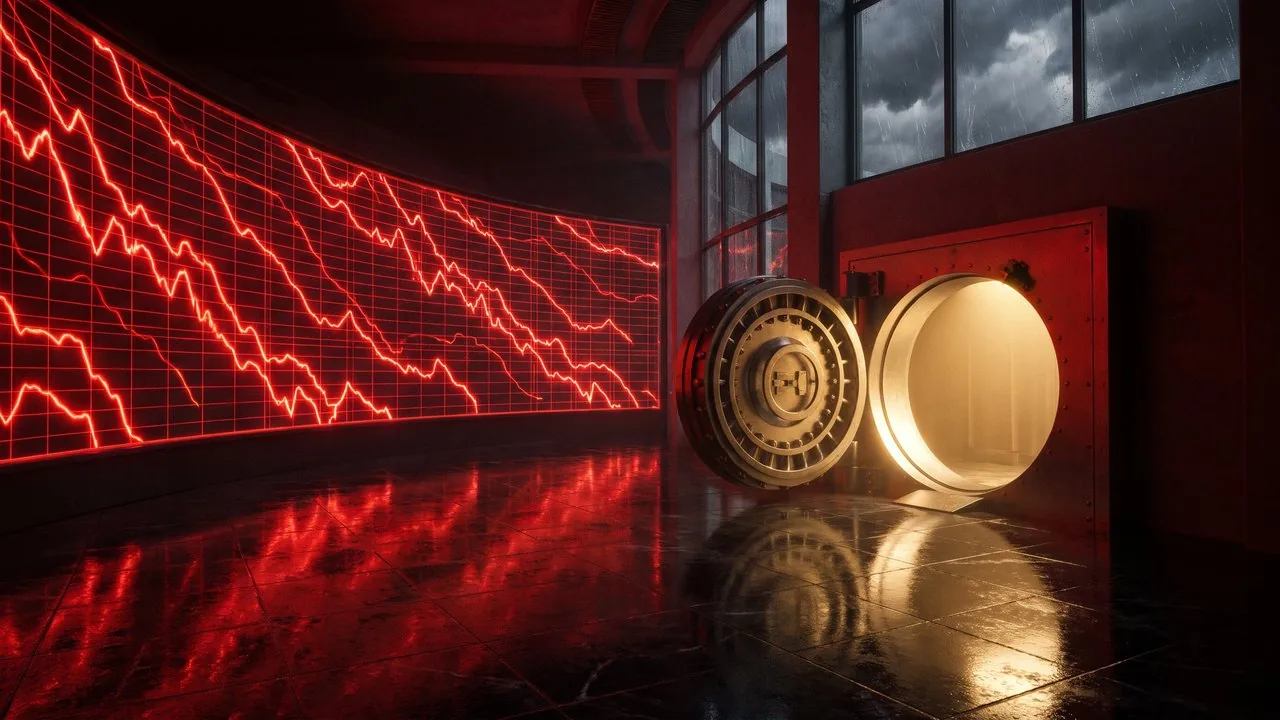
Stocks Lost Trillions in a Day. The Bond Market Had Been Whispering the Real Reason for Weeks
The Nasdaq's worst day in 19 months was blamed on the midterms and data center politics. But Treasury yields were already falling, credit markets were already demanding guarantees, and China's AI stocks had already cracked. Here is the bigger story.
Advertisement
Contents
- The day the AI trade cracked
- Not just a tech story
- What the bond market is saying
- The trigger: data centers became politics
- Is the wall electricity or demand
- The neocloud problem
- Even the giants are conserving cash
- The 63 billion dollar tell
- Energy shock and demand destruction
- What the Fed has to do with it
- China went first
- Everything had to go right
- Why this matters
- What to watch next
- Risks and counterpoints
- FAQ
- The bottom line
The day the AI trade cracked
Thursday, November 5, 2026, will be remembered as the day the AI trade blinked.
Two days after Democrats swept the midterm elections, the tech-heavy Nasdaq Composite fell 5.56%, its steepest one-day drop in 19 months, according to Reuters. It was the index's biggest fall since the April 2025 "liberation day" tariff shock, and it pushed the Nasdaq into correction territory, more than 10% below its recent record.
The damage was staggering:
- The Nasdaq lost an estimated $2.5 trillion in market value, the BBC reported.
- The "magnificent seven" shed about $1 trillion in a single session.
- Nvidia fell more than 9%. AMD sank more than 14%.
- Memory maker SanDisk tumbled 22% and Western Digital 17%, per The Guardian.
- Wall Street's fear gauge, the VIX, jumped 61%.
The selling went global the next day. Japan's Nikkei closed down 6%. South Korea's Kospi plunged more than 8% at one point, triggering a circuit breaker, before closing down 6%. Europe fell too, with Germany's DAX down 2.4%.
Advertisement
The headline explanation was simple: voters turned against data centers, and markets panicked about regulation.
That explanation is true. It is also incomplete.
Not just a tech story
If this were only about chip valuations, the damage would have stayed in chips.
It did not. Industrial bellwethers, big banks, aircraft makers and consumer brands fell alongside tech in the US selloff. One market analysis that circulated widely this week argued that each of those names tells its own story:
- Industrial equipment makers reflect construction and capital investment.
- Big banks reflect credit and the wider financial system.
- Aircraft makers reflect industrial demand and financing conditions.
- Consumer brands reflect household spending.
When all of those fall with Nvidia, the market is no longer asking only whether AI stocks are too expensive. It is asking whether the economy underneath them is weaker than it looked.
What the bond market is saying
Here is the part most headlines missed.
While stocks were crashing, US Treasury bonds were rallying. And not just for a day.
On November 5, the two-year Treasury yield dropped about 10 basis points to roughly 4.48%, its lowest level since early September. It had been falling for weeks, down close to half a percentage point from its recent high. The 10-year yield sat around 4.8%, roughly half a point below its peak.
When yields fall like that, it means investors are piling into government bonds. In plain English, the bond market is saying:
I can feel something coming. It will not be brief. I need somewhere safe to put my money.
Why the rally started before the election
This matters because the bond rally began long before election night. That suggests the stock crash was not a sudden surprise to fixed-income investors. It was a confirmation.
The analysis points to two forces that had pushed yields higher in September and early October:
- Seasonal pressure. Treasury markets often face strain at the end of the third quarter, when dealer balance sheets get tight and intermediaries are less willing to hold bonds.
- Fed expectations. Markets had priced a Fed that might respond aggressively to energy-driven inflation.
With September's seasonal effects gone, the argument goes, bonds were finally free to price fundamentals. And the fundamentals were getting worse.
The trigger: data centers became politics
The immediate catalyst was political.
Democrats flipped seven Senate seats, gained at least 39 House seats and picked up five governorships, Reuters reported. Many campaigned explicitly against data centers, and dozens of local ballot measures to restrict them passed.
According to a CNBC voter poll, 56% of voters said AI and data centers were a crucial or major factor in their vote. Of those, 65% backed a Democratic congressional candidate.
Then Senator Bernie Sanders posted:
"Americans don't want Big Tech oligarchs wrecking the environment, gutting jobs and threatening humanity's future. NATIONAL DATA CENTER MORATORIUM NOW."
A national moratorium is not law. It may never become law. That is not the point.
For years, markets assumed data centers could be built as fast as money, equipment and power allowed. Local opposition was treated as an inconvenience. The election told investors that the political cost of building is now real and rising.
Why a proposal can matter more than its odds
If lenders believe future construction is less predictable, the cost of financing rises before a single project is stopped. That is why one proposed moratorium can move markets far more than its probability of passing would suggest.
The industry's response
AI companies have seen this coming. Some have pledged to pay for grid upgrades, publish water usage and rebrand data centers as "compute campuses." Critics argue rebranding will not be enough. People need to feel the benefits in their own lives and wallets, or the backlash will keep growing.
Is the wall electricity or demand
This is the most important question in the whole story.
Data centers need enormous amounts of electricity and water, transmission lines, backup generation, cooling and land. Communities are being asked to tolerate higher power demand, new infrastructure and potentially higher utility bills. That is the "electricity wall."
But there is a second wall: demand.
The analysis makes a sharp distinction. The risk is not only that data centers do not get built. It is that the paying customers needed to fill them may not show up fast enough.
There are market rumors, and they are only rumors, that compute buyers who once paid premium prices are now being offered more hours at lower prices. If true, that would suggest some capacity has already been overbuilt relative to current demand.
If demand is there and construction is blocked, the bottleneck is politics. If demand is not there, the bottleneck is the business model. Investors are now trying to figure out which one they are facing.
The neocloud problem
The hardest-hit companies were the so-called neoclouds: firms that rent out GPU computing power without a giant advertising, retail or software business behind them.
Reported single-day declines included roughly 13% for CoreWeave and steeper drops for other GPU-cloud providers.
Their vulnerability is structural:
- They often need financing before revenue exists.
- Lenders fund GPUs, networking, land and power based on projections of what customers might pay later.
- If projects are delayed, revenue is delayed. If they are canceled, the expected revenue disappears, but the debt remains.
That mismatch between debt obligations and future revenue is, as the saying goes, a tale as old as time.
Even the giants are conserving cash
The biggest companies are not immune either.
- Amazon reported negative free cash flow in the third quarter, driven by about $77.3 billion in capital spending. Its trailing-12-month free cash flow was an outflow of roughly $42.4 billion. It expects around $220 billion in capex for 2026.
- Microsoft offered voluntary buyouts to roughly 60,000 eligible employees as it pushed capital efficiency during its AI buildout, CNBC reported.
- Alphabet faces large future commitments tied to data centers, compute and energy, while investors keep asking how AI will be monetized without eroding its search business.
That last point is underrated. If more people get answers directly from AI and click fewer links, search advertising faces pressure even if not another data center is built. The more people use AI assistants instead of search, the stranger things may get for Google's core revenue.
These are among the most profitable companies in history. They are now prioritizing AI spending over almost everything else.
The 63 billion dollar tell
One deal says a lot about how lenders view AI hardware.
In October, Bank of America, Blackstone, Citi and Morgan Stanley announced a $63 billion financing structure to buy Broadcom AI accelerators and networking gear for Anthropic, with deliveries starting in 2027. A special purpose vehicle buys the equipment and leases it to Anthropic.
The key detail: Broadcom is providing "residual value support." According to Broadcom's investor materials, its potential liability is any shortfall between 72.5% of the amount still owed on the lease and the value of the AI racks, with peak exposure of about $43 billion, declining over five years.
Read that again. Chips described as the most strategically valuable assets on earth apparently were not enough collateral on their own. Lenders wanted the supplier to backstop their value.
That does not mean the chips are worthless. It means lenders are pricing the possibility that they lose value faster than expected.
Energy shock and demand destruction
The broader economic argument is about energy.
High energy prices are often treated as an inflation problem. But when wages and credit are not growing fast enough, expensive energy works differently. It destroys demand.
The logic is simple:
- A household spends an extra $100 on gas and electricity.
- That is $100 it cannot spend at restaurants or stores.
- Businesses face higher transport, power and production costs.
- They cannot pass all of it on, because customers are already stretched.
- Sales volumes fall.
This is also offered as the explanation for why oil never hit the $200 a barrel some predicted. Demand fell instead.
The argument adds that consumer spending had been propped up by two groups: wealthier households at the top of a "K-shaped" economy, and lower-income households burning through savings and borrowing. As that runs out, the economy looks weaker than headline numbers suggested.
In this view, AI capital spending was one of the few major engines still running. If it slows, there is not much else to carry the economy.
What the Fed has to do with it
The analysis argues the Fed has been focused on headline inflation pressure from energy and raising rates in response, while the bond market has been pricing the real-economy weakness that energy shocks create.
The selloff shifted the odds. Options and futures pricing for a quarter-point hike in December fell from around 83% to roughly two-thirds on November 5. Strong October jobs data the next day pushed those odds back up toward about 80%, according to later market reports.
That whiplash is the point. The worse the economic outlook gets, the less room the Fed has to keep raising rates before something breaks.
There is one charitable reading of a hawkish Fed worth noting: if the goal is to cool an overheated flood of money into AI, higher rates would do exactly that. Whether that is wise is another debate.
China went first
The US is not the only country asking these questions. China may already be further along.
Reuters reported that in China, the AI bubble "has already burst." China's STAR 50 technology index fell about 40% from its July peak, erasing roughly half a trillion dollars in value. The CSI 300 dropped about 8.5% in October, its worst month in a decade.
Beijing responded with its usual playbook:
- Central bank swap operations for securities firms and fund managers
- Cheaper financing for share buybacks
- Encouragement for big tech firms to repurchase their stock
So far, those measures have not produced a durable recovery. And that is the warning. Liquidity can slow a decline. Buybacks create temporary demand. But none of it can manufacture profitable end demand for AI services.
Everything had to go right
Here is the cleanest way to understand the selloff. For AI valuations to make sense, all of this had to stay true at once:
- Data centers had to be approved.
- Power had to be available.
- Chips had to hold their value.
- Financing had to stay cheap.
- AI demand had to grow exponentially, continuously.
- Customers had to accept profitable prices.
- The broader economy had to stay strong enough to support it all.
The election did not build the wall. It may have accelerated the industry straight into a wall that was already there.
Why this matters
- For investors: concentration risk is real. Many portfolios are heavily tilted to a handful of AI names.
- For workers and businesses: AI spending has been supporting jobs and growth well beyond tech. A slowdown would ripple outward.
- For the AI industry: the social license to build is now a financial variable. Public trust affects borrowing costs.
What to watch next
- Treasury yields. Continued falling yields signal growing fear about growth.
- Credit spreads and financing terms for AI infrastructure deals.
- Compute pricing. Falling rental prices for GPUs would point to a demand wall.
- Fed decisions in December, and how inflation data comes in.
- State and local data center rules after the midterms.
- Holiday spending, a real-time read on consumer demand.
Risks and counterpoints
- One bad day is not a bust. Even after the drop, the BBC noted the Nasdaq was still higher than a year earlier.
- Politics can change. Moratorium calls may never become law, and states compete for investment.
- Demand may catch up. New models and agents could generate the usage that justifies the buildout.
- Bond rallies have many causes. Falling yields can reflect global flows, not just US recession fears.
- This is one interpretation. The demand-destruction thesis is an argument, not a forecast anyone can guarantee.
FAQ
Why did stocks crash after the 2026 midterms?
Investors feared Democrats would use their gains to restrict data centers and regulate AI, threatening the infrastructure buildout that powered market gains.
What does a Treasury rally mean?
Bond prices rise and yields fall when investors seek safety. A sustained rally often signals concern about economic growth.
Is the AI bubble bursting?
Not fully, at least not in the US. But warning signs are piling up in more places, from credit markets to China's tech stocks.
What is residual value support?
A promise by a party, here Broadcom, to cover some of the loss if financed equipment is worth less than expected later.
The bottom line
Stocks are pricing a direct threat to AI earnings. Bonds are pricing something bigger: what happens to the whole economy if that AI value never fully materializes.
When stocks and bonds start sending the same message, it is hard to dismiss it as a post-election hangover. The real question is no longer whether the AI boom will cool. It is how hard, and how soon.
Sources
- Reuters, Democrats' election win spooks AI investors, hammering stocks
- CNBC, Top Democrats call to rein in AI buildout after midterms sweep
- The Guardian, Nasdaq sees worst day in 19 months as investors bet on AI slowdown
- BBC News, Global tech stocks plunge as US midterms add to AI slowdown fears
- CNBC, Treasury yields as traders look ahead to jobs data
- Broadcom, $63 billion financing structure for Anthropic compute
- Amazon, Third quarter 2026 results
- CNBC, Microsoft offers voluntary buyouts
- Reuters via Investing.com, In China, the AI bubble has already burst
More stories you'll want to read
$10K in 14 days12 minA brand-new store, one kids' art frame, AI-built ads and a $50 test budget. Fourteen days later it had crossed $10,000 in sales. The daily profit numbers, the losing days and the one change that finally worked are the real lesson.Read now →
 The key-man test14 minNvidia's founder resigned effective immediately after a week of scandal, leaving the company at the center of the AI economy without the man who built it. The real question now is whether Nvidia's dominance was the product of one person, or a machine that can run without him.Read now →
 MIT study12 minHot takes say AI already erased whole professions. Careful studies usually find something sharper: specific tasks die first, job titles lag, and the winners rewrite workflows instead of waiting for extinction memes.Read now →
 Trade bot12 minBeginner guides that pair Claude with broker APIs can be educational — if they start with paper trading, risk caps, and the assumption that the market is not a tutorial NPC.Read now →
 10 AI gigs ranked12 minEveryone wants to vibe-code an app. It's actually the hardest way to make your first AI dollar. Here are 10 one-person AI businesses ranked by how fast you can land a paying customer, with the math, the offers and the traps.Read now →
 Devs vs. the AI push12 minWhen a community of developers was invited to ask anything about their lives, most questions weren't about sleep or dating. They were about AI killing the joy of coding, impossible deadlines and bosses sold on hype. Here's what the research says, and how to handle it without becoming the office naysayer.Read now →