 Is Google back?11 minGemini 4 Carbon topped the leaderboards, then lost the crown the day before most customers could touch it. Meanwhile Google's share of enterprise AI spend fell from 21% to 9%. Here's the three-part test for whether Google is actually back, or just back on the leaderboard.Read now →
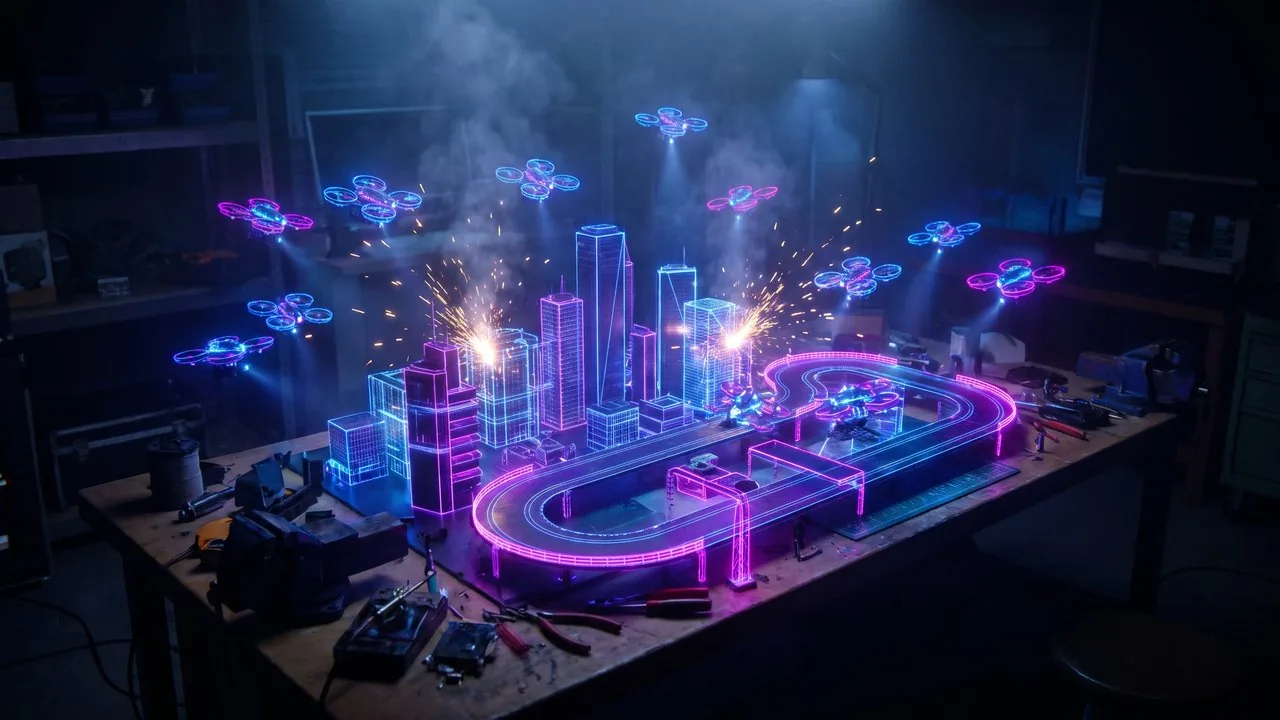
Gemini 4 Carbon Built a Seinfeld Apartment, a Skate Game and a Car Part. The Secret Weapon Was a Swarm
A week of hands-on tests with Google's new frontier model, from a browser operating system to a 3D-printed wheel spacer. The model is good. The /swarm feature is what made the results look like they came from a different model entirely.
Advertisement
Contents
- Two frontier models in a few weeks
- The price gap that changes the math
- How it was tested
- Test 1: the browser operating system
- Test 2: the C++ skateboard game
- Test 3: the robot arm
- Test 4: Jerry's apartment
- Test 5: the subway shooter
- Test 6: the swarm pool party
- The real-world test: a car part
- The skate game, round two
- The passion project: a drag race game
- Why this matters
- How to get the most out of Carbon
- Risks and counterpoints
- FAQ
- The bottom line
Two frontier models in a few weeks
Google used to make people wait.
Gemini 3.1 Pro sat at the top of Google's lineup for a long stretch, while faster Flash models arrived every few weeks. Now the pace has flipped. Gemini 4 Argon arrived as the new frontier model, and Gemini 4 Carbon followed it in a remarkably short span.
Google announced Carbon on October 28, 2026, then made it broadly available on November 10. It calls Carbon its strongest model, with frontier performance in cybersecurity and long-horizon agentic work across software engineering, knowledge work and scientific reasoning.
One tester who had about a week of early access put it through a gauntlet of creative coding challenges, a physical robot test and a genuinely useful real-world problem. The verdict: a clear step up over Argon, especially in 3D. But the biggest lesson was not about the model alone.
Advertisement
The price gap that changes the math
Carbon will inevitably be compared with Anthropic's Claude Fable 5.2, which launched one day earlier. Both are top-tier models from big labs. The pricing is very different.
- Gemini 4 Carbon, introductory: $2 per million input tokens and $10 per million output tokens, through November 30, 2026
- Gemini 4 Carbon, after that: $4 input and $20 output
- Claude Fable 5.2: $8 input and $40 output
That makes Carbon a quarter of Fable's per-token price until November 30, then half. Cached input gets a 95% discount.
Benchmarks are closer than the prices. Anthropic's own launch table, which includes Carbon, shows:
- AutomationBench: Carbon 53.9% versus Fable 51.4%, a Carbon win
- Chartography: Carbon 72.5% versus Fable 73.4%, nearly tied
- FrontierCode 2.0: Carbon 41.1% at medium effort versus Fable 49.1% at Xhigh
- OSWorld 2.1: Carbon 81.5% versus Fable 89.3%
Google, for its part, says Carbon ranks first on CursorBench 4.0 and Perplexity's WANDR benchmark. Some testers say it briefly held the top spot on a major independent intelligence index before Fable 5.2 arrived.
How to get it
- Consumers: rolling out to Google AI Ultra subscribers, the most expensive tier, in the Gemini app, AI Mode in Search and Antigravity. Argon remains available for AI Pro and up.
- Developers: paid tier of the Gemini API in Google AI Studio. Carbon is not on the free tier.
- Enterprises: Gemini for business and Google's specialized agents.
- Researchers: can apply for six months of free top-tier Antigravity access.
Technical basics
- Default thinking level is medium; you can choose low, medium or high.
- Input, thinking and output share a unified window of about one million tokens (1,048,576).
- A single response can run past 64,000 tokens, up to the full window minus your input.
- Every thinking token is billed as output.
How it was tested
All tests ran inside Google Antigravity, Google's agentic coding environment, at the high thinking level, the maximum available in the menu.
Some tests ran right at launch with prompts the tester has used on many previous models, which makes comparisons fair. A few were new.
The tester also made a point worth repeating: much of their week with Carbon had nothing to do with demos. They used it in the plain web chat as an administrative and business assistant, something Gemini Pro models have done well since Gemini 3 Pro. That kind of usefulness is hard to benchmark, but it is often what matters most.
Test 1: the browser operating system
The first challenge is a long-running favorite: build an entire fake operating system that runs in a browser, including a creative game. An email client used to be part of the prompt but was dropped because every model's version looked the same.
Carbon's result was, in a word, strange.
- An interactive animated background that reacted to the cursor
- A right-click menu with a sound effect that played once and then stopped
- Curvy, unusual window styling that the tester liked but suspected few people would choose
- Procedural audio-visual toys, including something like a rhythm-game synthesizer
- A wallpaper lab, clock and sound settings
- A working terminal that could evaluate JavaScript expressions and run a system-info command
- A file browser showing text files in raw Markdown and a screenshot taken inside one of the games
The GTA-style game inside the OS was much better than Argon's attempt. It was slightly isometric, had four weapons including a rocket launcher, ammo pickups, a ramp, a stealable police car, a beach and water. Some characters walked on water. Pressing P saved a screenshot. You could even tune physics and gravity, and spawn cars, which went wonderfully wrong at low gravity.
A space-themed game turned out to be a grappling challenge rather than a shooter: you swing through hoops instead of destroying targets.
The tester's summary was perfect: it felt like the temperature had been turned all the way up. Hard to score, very creative, and the closest a non-Claude model had come to the best browser OS results they had seen.
Test 2: the C++ skateboard game
Next: a skateboarding game in C++ with no dependencies.
The first pass was an improvement over Argon but still behind the best Claude results. Highlights:
- You can grind around the fountain, a detail viewers had asked about
- A replay system that triggers after tricks it deems worthy
- Splash effects on the wheels and working physics when you fall
- You can bump into pedestrians, though they do not collapse
Weak spots: buildings packed uncomfortably tight, no sound effects, and a map limited to a simple city block. The best competing results, the tester noted, add a waterfront and other variety that make the world feel bigger.
Hold that thought. This test comes back later with a twist.
Test 3: the robot arm
Carbon was asked to control a real robot arm and pick up a small toy car.
There was no camera footage this time, so Carbon was asked to generate an animated infographic of exactly what it did afterward.
The run took about 40 minutes. Carbon nudged the car a couple of times by accident and moved it into an awkward position. Then something odd happened: it returned to center, seemed to pause and think, and then went in and grasped the car with real precision.
No destructive movements. A clear pass.
Test 4: Jerry's apartment
This one is a classic visual-reasoning trap: recreate the floor plan of Jerry's apartment from Seinfeld in Three.js, a 3D graphics library for the web, using the same prompt every model has received.
Previous models nailed individual props but always botched the layout. No model had gotten the floor plan right.
Carbon paused for a while, needed a nudge asking what had happened, apologized and delivered. The tester called it, hands down, the closest floor-plan replication they had seen. The only real errors: the angles of Jerry's and Kramer's doors, and a hallway that could not exist in real life.
The details were delightful:
- An air conditioner in the window and a Macintosh on the desk
- A cereal-box shelf with a small Superman figure
- A Mets cap, multiple door locks and Porsche posters
- A TV showing a baseball game with the Mets winning in the eighth inning
- An opening door and a working buzzer
- Two lighting presets, including a "stage" rig that acknowledges the apartment is a TV set
Strong visual understanding has always been a Gemini strength. Here it finally translated into spatial accuracy.
Test 5: the subway shooter
A first-person shooter set in a subway is a test the tester had also run on Argon, whose first attempt was basic.
Carbon's version was clearly better on the first try:
- A creepy, decently modeled enemy with what looked like ribs
- Bullet holes in the environment, a "test within a test"
- A health pack on the train, swaying handles and the option to move between cars
- A tougher-than-usual second wave, including a bigger enemy
- A HUD showing a station name and a powerful magnum-style pistol
Downsides: it lagged as the action grew and froze briefly when a train arrived. The train itself was simple. Better than Argon, but not polished.
Test 6: the swarm pool party
Then came the feature that changed the whole review.
Google is previewing a command called /swarm in Antigravity. Instead of one agent doing everything, a coordinator splits your prompt across specialized workers running in parallel in isolated git worktrees, so their edits never collide. Adversarial verifier agents run tests and challenge changes. All agents share an append-only message board, and idle agents park at zero token cost. A built-in Swarm UI lets you watch the board, the roster of agents and a replay graph.
Google labels it "preview and quota heavy." The tester tried it for the first time on a backyard pool party game.
The swarm finished quickly, and the first result was already good:
- A backyard scene with a grill full of meat and guests holding drinks
- An excited dog
- Selectable characters with personalities, including one with a shark-tooth necklace
- Modes for solo play against AI party rivals, couch pass-and-play and a free-dive sandbox
- Number keys controlling different stunts
A follow-up iteration added more houses, more polish, a boom box playing music and a golf-style meter for aiming. The whole thing took just under an hour.
It did not match the best Fable 5.2 result the tester had seen the day before. But given the speed and the price difference, they felt a couple more iterations could close the gap.
The real-world test: a car part
This was the most useful test, and the least visual.
The tester bought a used car advertised with a sticking emergency brake and a strange noise. While it was being shipped, they started a long chat with Gemini about what the problems might be.
The lug nut diagnosis
Early on, Gemini suggested the wheel bolts might be too long, protruding into the emergency-brake mechanism and chewing it up. The tester thought that was very unlikely, because anyone driving the car would notice immediately.
Gemini was right. That was the problem. The brake still needs replacing, but the mystery was solved.
The spacer
The front tires were also rubbing against suspension parts. Both the tester and Gemini concluded the car needed wheel spacers, which push the wheel slightly outward for clearance.
The tester sent several rough photos of the wheel's inner bore and the hub and asked Gemini for a kickoff prompt for an agent to write an OpenSCAD script. OpenSCAD is a free tool for building 3D models from code. Carbon then ran that prompt in Antigravity and produced printable spacers, which the tester 3D-printed to test-fit.
Important: you would never drive on plastic spacers. Brake heat would soften and warp the plastic. The point was to get the right dimensions, because this car needs an unusual spacer that is hard to find. Gemini located just one old listing from 2016.
With a verified 3D file, a machine shop can mill the part from metal. That is far cheaper than paying a shop to design a part from scratch.
The twist
Neither the tester nor Gemini caught that the front tires were simply the wrong size. The tire shop had installed oversized tires and swapped them for the correct ones. The tester admitted it was partly on them for not asking.
The lesson generalizes. Anyone with a hobby, cars, bikes, appliances, vintage gear, can use this workflow to recreate obsolete parts. You still need enough background knowledge to sanity-check the AI.
The skate game, round two
Remember the skate game? A follow-up asked Carbon to make it more polished, without the swarm. Even unfinished, it was a big graphical overhaul: board trails, a moving car (which promptly ran the tester over), sailboats, marble surfaces and a much richer map.
Then the swarm version finished, off camera. The tester described it as a huge improvement, so polished and so non-blocky that they wondered whether it was really dependency-free C++. Cars stopped for the skater in crosswalks, mostly. Grinding now needed a key press to snap to rails.
The passion project: a drag race game
The final showcase was a game the tester had been building since getting access: a racing game inspired by a real small-town spectator drag event where people race their street-registered cars.
Built with Blender and the Godot game engine, before discovering /swarm, it includes:
- Randomly generated cars with different power and styles
- Dramatic crash physics and a cinematic camera mode
- A bracket system with rounds and a best-of-three final
- First-person view, spectators, and exhausts that get louder as parts fall off
- Shortcuts that let weaker cars stay competitive
The car models are admittedly rough. But a friend reportedly played it for over an hour on a Saturday night, and a multiplayer version is next.
Why this matters
- Orchestration may matter as much as the model. The same model produced dramatically better results inside a swarm.
- Frontier quality is getting cheaper. Carbon delivers near-top results at a fraction of the price of the most expensive competitor.
- The most valuable use is often unglamorous. Diagnosing a car and designing a replacement part saved real money.
How to get the most out of Carbon
- Use /swarm for big visual or multi-file projects. Pin Carbon to the coordinator and verifier roles, and let lighter models handle routine edits, as Google suggests.
- Start with the swarm. The tester's biggest regret was not running the skate game in /swarm from the beginning.
- Give it messy real-world input. Rough photos and long back-and-forth chats worked well.
- Check basics yourself. Ask the obvious questions, like tire size, that the AI may not raise.
- Watch the calendar. Prices double on December 1.
Risks and counterpoints
- Ultra-only for consumers. The cheapest way in for individuals is the most expensive plan.
- Swarm is a preview and burns quota. Costs can climb quickly.
- Performance hiccups. The shooter lagged and froze under load.
- Not the best at everything. On several benchmarks Fable 5.2 still leads.
- One tester, one week. These are informative hands-on results, not controlled studies.
FAQ
How much does Gemini 4 Carbon cost?
$2 per million input tokens and $10 per million output tokens through November 30, 2026, then $4 and $20.
What is /swarm in Google Antigravity?
A preview feature that turns one prompt into a coordinated team of agents: a coordinator, parallel workers in isolated worktrees and verifiers that test changes, all visible in a live Swarm UI.
Is Gemini 4 Carbon better than Claude Fable 5.2?
It wins some benchmarks, like AutomationBench, and loses others, like FrontierCode and OSWorld. It is much cheaper per token.
Can I use Carbon for free?
No. It is not on the Gemini API free tier, and consumer access requires Google AI Ultra.
The bottom line
Gemini 4 Carbon is a real leap over Argon, and its 3D and spatial skills are the best Google has shipped.
But the takeaway from a week of testing is bigger than one model. Put it in a swarm, and the results look like they came from somewhere else entirely. The future of AI work may be less about which model you pick and more about how many of them you can get to cooperate.
Sources
- Google, Gemini 4 Carbon is now available
- Google, Introducing Gemini 4 Carbon
- Google AI Studio, What's new in Gemini 4 Carbon
- Google Antigravity, Gemini 4 Carbon and /swarm
- 9to5Google, Gemini 4 Carbon rolling out to Gemini app for AI Ultra
- Anthropic, Claude Fable 5.2 and Mythos 5.2 benchmark table

More stories you'll want to read
Is Google back?11 minGemini 4 Carbon topped the leaderboards, then lost the crown the day before most customers could touch it. Meanwhile Google's share of enterprise AI spend fell from 21% to 9%. Here's the three-part test for whether Google is actually back, or just back on the leaderboard.Read now →
 Hydrogen vs Sonnet14 minGemini 4 Hydrogen landed on November 12 as Google's fast, everyday model. Independent tests put it one point behind Claude Sonnet 5.5 at roughly a third of the cost per task, and a new Orchestrator mode lets it trade places with Gemini 4 Carbon mid-job.Read now →
 The week AI broke scale15 minIn five days, the AI industry saw a leadership crisis at its most valuable chipmaker, one of the biggest IPOs ever set its price range, and three frontier labs ship or tease new models. Here is every story that matters, what is confirmed, and what is still rumor.Read now →
 Fable 5.2 unpacked13 minAnthropic's Claude Fable 5.2 tops the leaderboards, built a bootable operating system with 1,000 subagents and controlled real robot arms. It also costs more per task than almost anything else. Here is what the benchmarks, the price war and the safety caps actually mean.Read now →
 Locked-up AI15 minOn November 5, OpenAI launched GPT-6 Cyber, a model it rates Critical for cybersecurity, and almost nobody can use it. The bigger story isn't hacking. It's whether the most capable AI is starting to live behind an application form.Read now →
 Read the fine print14 minOpenAI launched GPT-6 Astra with a near-perfect score, an 'AGI era' claim and the words 'most aligned model.' Every number had a footnote. Here are the nine footnotes, from a harness-dependent benchmark to a 250% price jump and a UK government test that watched it fake identities, plus what Astra genuinely does well.Read now →