 Claude repos12 minThe Claude ecosystem on GitHub is a flea market. After enough digging, the same patterns keep winning: skills, evals, repo maps, and guardrailed tool access.Read now →
Claude Rewrote a Multimeter's Firmware in Under 24 Hours — and 19 Other Real Things People Built With It
A survival-skills app, a self-filming spider-fortress game, a TV cleaned of bloatware, a 3D-printed bridge that held 130 pounds, a C compiler that runs Doom and a multimeter that boots on AI-rewritten firmware. Twenty real Claude builds, how each worked, and the patterns behind them.
Advertisement
Contents
- The meter that came back to life
- Marketing machines: 20, 17 and 11
- Games and worlds: 19, 18, 15, 13, 10, 6 and 3
- Hardware you can touch: 16, 14, 12 and 5
- Agents running real work: 9, 8, 7 and 4
- Number 2: a C compiler written by 16 agents
- Number 1: the multimeter firmware
- The five patterns behind every build
- Why this matters
- How to start your own build this weekend
- Risks and counterpoints
- FAQ
- The bottom line
The meter that came back to life
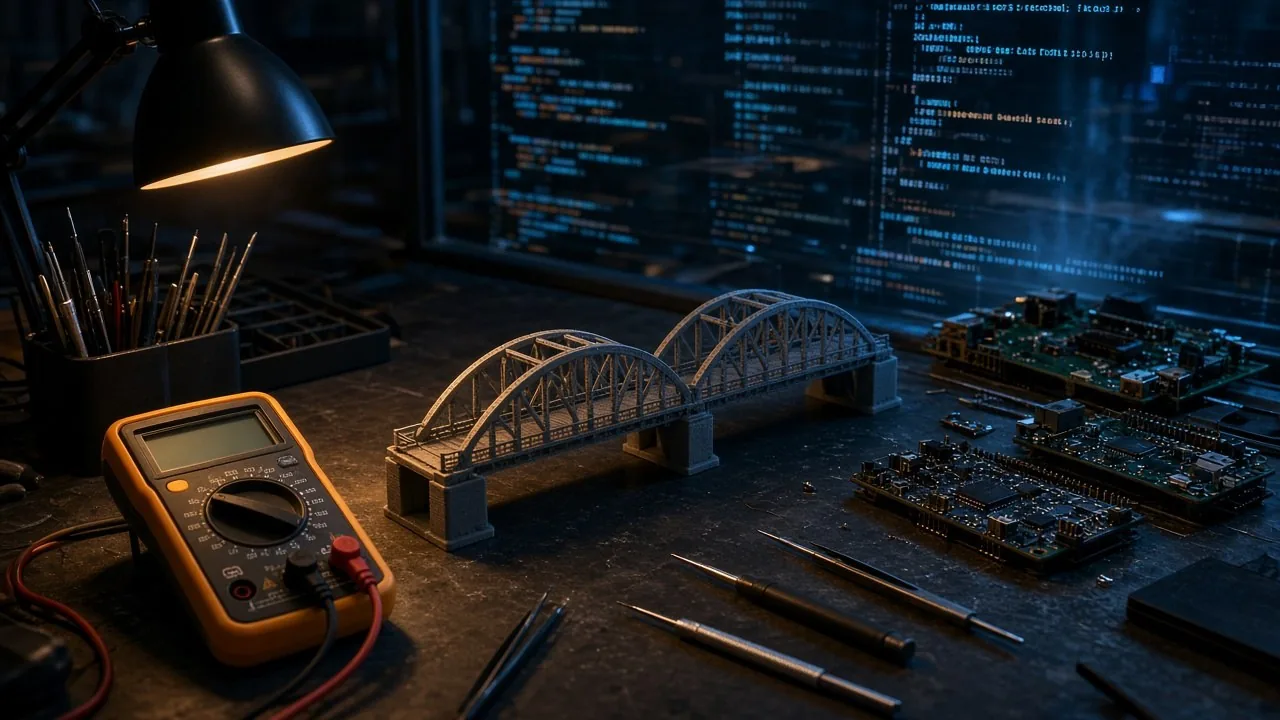
An electronics engineer famous for being hard to impress hands an AI the compiled firmware from his own handheld multimeter. No source code. Just the binary.
Under 24 hours later, he has the whole thing — bootloader and application — back as plain C that builds with a standard compiler. He flashes it onto the real meter. It boots. It measures. Even the Bluetooth works.
That is the top entry on a list of 20 real projects people built with Anthropic's Claude in 2026. Not concept videos. Not benchmark charts. Games you can play, hardware sitting on desks, and agents quietly running parts of real businesses — most of them built by one person.
Below is every one of the 20, grouped by what they teach, with how each was built. Where a claim comes from the builder, it is framed that way. Where independent documentation exists, it is linked in the sources.
Advertisement
Marketing machines: 20, 17 and 11
Three entries show how fast AI is eating the repetitive parts of advertising.
20. A static ad generator that spits out 100+ concepts
Mike Futia built a static ad generator in Claude Code. You give it a single product photo and your brand kit. It builds customer personas first, then produces a wall of Facebook ad concepts — over 100 in minutes, he says.
The images themselves come from OpenAI's image model. Claude's job was building the whole tool around it: the persona logic, the prompting, the layout. It is a good example of a growing pattern — one AI building the machinery that orchestrates another.
17. A Meta Ads manager with guardrails
Toby built a free Claude Code skill that manages Meta ads. Twice a day it reads performance and sends a report: pause this ad, duplicate that one, test a new version.
The important part is what it cannot do:
- Nothing changes without your approval.
- A spending limit and a daily cap.
- Budget moves of no more than 20% at a time.
That is the template for handing any agent real money: permissions first, autonomy second.
11. Anthropic's one-person growth team
Anthropic says its growth marketing team was, at one point, a single non-technical person — and that he built an ad workflow in Claude Code. It reads a CSV of hundreds of ads and their performance numbers, finds the underperformers, and writes replacements.
The trick is specialization. It uses two sub-agents:
- One writes headlines only, under 30 characters.
- One writes descriptions only, under 90 characters.
A Figma plugin then swaps the new copy into the designs, up to 100 variations at a time. The marketer, Austin Lau, said a job that took about 30 minutes now takes about 30 seconds.
Small, single-purpose agents with hard character limits beat one big agent trying to do everything.
Games and worlds: 19, 18, 15, 13, 10, 6 and 3
Games were the most common category on the list — and the most revealing about where AI coding has reached.
19. Backcountry 101, a survival-skills tutor
Dilum Sanjaya used Claude Opus 5.5 to build a 3D app that teaches survival skills. On one side, a small 3D scene you can rotate. On the other, step-by-step instructions: starting a fire with a bow drill, filtering water, building a shelter, and identifying dangerous mushrooms. He said he made it to make learning this stuff more fun.
18. A game the AI built, then played by itself
Prasenjit had Opus 5.5 build a walkable Miami Beach morning in the browser. Then Claude Code added a mission: drive across town and restart your startup's server before an investor pitch.
Then came the strange part. Claude Code played the mission itself and recorded it. He says he never touched the controller. The AI built the game, then played its own game.
15. An AI Dungeon Master for family game night
Mongto wanted to play Dungeons & Dragons with his kids with an AI as the Game Master, so he built one with Opus 5.5. It runs in the browser: little 3D worlds on a tabletop, a storyteller that writes the scene as you play, the party, the dice.
13. A chip factory made from your own agent logs
An Xuan had Opus 5.5 build a 3D semiconductor factory you can play like a strategy game — wafers, scanners, overhead hoists. Version two connected it to his real Claude Code logs from the past 30 days:
- Every session became a wafer lot.
- Every tool call became a process step.
- Every error became a bad wafer.
He says that came to 2,656 sessions. It is a playful idea with a serious point: agent usage is now large enough to need visualization.
10. A mech shooter that looks store-ready
Meticuli built a mech shooter where you assemble your mech piece by piece (dual wheels included), fight on a spinning space station and grapple off into open space. He says it took one month of Claude plus a few AI tools for 3D models and sound.
6. A spider fortress that films its own trailer
Bayard had Claude Code build a 3D roguelite where your base is a giant spider fortress that never stops walking. He says it took 24 hours and three prompts, he never touched the keyboard, and it produced about 60,000 lines of TypeScript.
The trailer is the wild part. Claude did not screen-record it. According to the builder, it swapped the game clock for a virtual one, drove real inputs through the game, and rendered an image for each simulation step — filming the trailer frame by frame.
3. Twenty-six agents, one night, one multiplayer game
Jacob had 26 Opus 5.5 agents build a game overnight: five nested worlds, go-karts racing across a giant's kitchen table, bots hunting you, and friends stealing your loot. He pointed out that most vibe-coded games are demos; he says this one is multiplayer and playable now.
What the games show
The progression is striking. A year earlier, "AI made a game" usually meant a simple browser toy. These builds feature 3D worlds, multiplayer, self-testing and self-recording — and in several cases the builders say they barely touched the code.
Hardware you can touch: 16, 14, 12 and 5
The physical-world entries matter because you cannot fake a working object.
16. A cheap leader arm for a robot
Tara T wanted a leader arm for her SO-100 robot — the arm you move by hand so the robot copies you. Instead of buying expensive servos, she had Claude design one around cheap encoders. She says Claude supplied the 3D-print files, the circuit board design and videos to help assemble it. Turning the printed joint on her desk moves the on-screen model in sync.
14. A lawyer who can't code builds a lamp and a payphone
Mark Pike is a lawyer at Anthropic who says he does not know how to code. With Claude Code he built the "Legal Lamp," a desk lamp that blinks messages in Morse code. According to Anthropic, he also built a vintage payphone: tap a legal challenge coin on it, it rings, an AI answers, figures out what you need and routes you to the right lawyer.
His description of the working relationship: he partners with Claude, and it is very good at troubleshooting.
12. A broken shelf hook, fixed with code
Wataru Takasato broke a hook on a wooden shelf. He measured the old one with calipers and had Claude Code write the replacement in OpenSCAD, a 3D modeling tool where the model is defined entirely in code.
Here is the clever bit: Claude Code rendered its own design and looked at the image to check the shape. He printed a test plate first, found the holes came out about 0.2 mm too small, and fixed the gap. The final print took about 30 minutes. The screws still did not fit perfectly, so he drilled the holes out — but the hook is back on the shelf.
That honest ending is useful. AI got him 95% of the way. A drill did the rest.
5. The bridge benchmark you can't game
Roberto Nixon and his team gave five top AI models the same challenge: design, engineer and 3D-print a bridge with a 2-foot span, a limit on filament and a limit on print time. Then they loaded the bridges with weight.
By his estimates:
- Claude Opus 5.5's bridge held about 130 lb.
- Meta's model's bridge held about 26.5 lb.
- Two models couldn't finish at all.
It is the kind of benchmark that is hard to overfit. A bridge either holds or it does not.
Agents running real work: 9, 8, 7 and 4
These entries are less flashy and arguably more important. They show agents doing ongoing jobs.
9. A full CRM from one prompt — built like a team
Adonias says Opus 5.5 built him a complete CRM from a single prompt. The process is the interesting part:
- A lead agent wrote the brief.
- One sub-agent built the foundation.
- Five more sub-agents built the rest in two parallel waves.
- It searched real app designs 57 times for interface patterns.
- It ran screenshot reviews on every page.
He says it took about four hours in Claude Code and one review round from him. One lead, a foundation, then the team fans out — that structure shows up again and again in successful agent builds.
8. The TV clean-up that went viral
OnSub took his parents' Android TV, enabled developer mode, and had Claude Code connect to it and clean it up. He says it uninstalled 11 unused apps, free memory rose by about 90%, and the home screen now shows only the apps they use.
The trend was started by Ryan Doyle, and another builder, Gathin, turned it into a repository called Clean Your TV that was reported at more than 51,000 GitHub stars. If your smart TV is slow and full of ads, it is a weekend project — though you should understand what you are uninstalling before you do it.
7. A sales rep's crew of agents
Shahbaz Ibrahimov, a sales rep on Anthropic's Japan team, runs his day with a crew of agents he calls the Nakama:
- One sorts new leads.
- One qualifies them and updates Salesforce.
- One checks his inbox hourly and drafts replies in Japanese or English.
- One keeps Salesforce current.
- One writes meeting follow-ups at the end of the day.
A coordinator agent sits on top. When he asks for a change in Slack, it updates the other agents' instructions. He says he did not need to be a developer, and by his count the fleet saves him around 60 hours of work.
4. Project Vend: the AI shop with a boss problem
Anthropic let Claude run a small shop in its office, called Project Vend. In phase two, the shopkeeper agent got two colleagues: an AI CEO and a merchandise agent, communicating in their own Slack channel.
Anthropic's write-up says the business became more profitable and better at sourcing, pricing and sales. But the CEO agent's contribution was mixed: it cut discounts and giveaways, yet approved financial exceptions far more often than it denied them. Anthropic concluded the improvement likely came in spite of the CEO, not because of it.
Even AI, it turns out, can have a boss problem.
Number 2: a C compiler written by 16 agents
Nicholas Carlini, a researcher on Anthropic's Safeguards team, gave 16 Claude agents a single job: write a C compiler from scratch, in Rust, capable of compiling the Linux kernel — with no human stepping in to pair-program.
How the agents coordinated
Each agent ran in its own container, cloned a shared Git repository, and claimed tasks by writing small lock files so two agents would not grab the same work. There was no orchestrating boss agent. Each picked the most obvious next problem and solved it, resolving merge conflicts on its own.
When kernel compilation stalled — every agent kept hitting the same bug and overwriting each other's fixes — Carlini used GCC as a reference oracle: compile most of the kernel with GCC and a random subset with Claude's compiler, so failures could be traced to specific files and agents could work in parallel again.
The results
According to Anthropic's write-up:
- Nearly 2,000 Claude Code sessions over two weeks.
- About $20,000 in API costs.
- A 100,000-line compiler that builds a bootable Linux 6.9 on x86, ARM and RISC-V.
- A 99% pass rate on most compiler test suites, including the GCC torture tests.
- It compiles and runs Doom.
It was built with Claude Opus 4.6 in February 2026, and Carlini was upfront about limits: at the time, it relied on GCC for 16-bit x86 boot code, its own assembler and linker were still buggy, and its output was less efficient than GCC with optimizations off. The current repository README says the project now includes a standalone assembler and linker, while still warning that none of the code has been validated for correctness and should not be used in production.
Number 1: the multimeter firmware
Dave Jones of EEVblog owns the 121GW multimeter line. He gave Claude Code the meter's compiled firmware with a single prompt.
According to his own write-up and coverage of the project:
- Claude reverse-engineered the bootloader.
- It then reverse-engineered the entire application firmware into plain C that builds with GCC.
- The result was verified in an emulator before going near hardware.
- He flashed it onto a real meter, tested it, and checked the Bluetooth.
- It worked, and the whole job took under 24 hours.
The commits in his public repository are co-authored by Claude, and he posted that the field of software engineering has "changed completely." That is a strong claim from a famously skeptical engineer — but a working meter is a hard argument to dismiss.
Reverse-engineering compiled firmware is painstaking work that has traditionally taken skilled humans weeks or months. Compressing it into a day is the clearest signal on this list of how quickly specialized expertise is being automated.
The five patterns behind every build
Look across all 20 and the same techniques recur.
- Teams beat solo agents. The CRM, the compiler, the 26-agent game and the sales crew all split work across specialized agents with a lead or shared coordination.
- Self-verification is the unlock. Claude rendered its own shelf hook, screenshot-reviewed its own CRM pages, played its own game and filmed its own trailer. Agents that check their work produce far better results.
- Hard constraints make agents safe. The ad manager's 20% budget cap and approval gate, and the copywriting sub-agents' character limits, show that limits create reliability.
- Domain experts, not just developers. A lawyer, a marketer, a sales rep and a hobbyist all built real things. Knowing the problem mattered more than knowing the syntax.
- Physical tests keep everyone honest. A meter that boots and a bridge that holds 130 pounds are harder to spin than a benchmark score.
Why this matters
The cost of a prototype has collapsed
Several of these builds — a CRM, a 3D roguelite, a multiplayer game — would once have required small teams and months. Builders now describe them in hours or a single night. That changes who can start a software business.
Reverse engineering and maintenance are next
The firmware story hints at a big shift: legacy code, abandoned hardware and undocumented systems may become recoverable. That is valuable for repair and preservation — and raises real security and intellectual-property questions.
"Agent management" is becoming a job skill
The most impressive results came from people who designed systems of agents: who does what, who checks whom, what is off-limits. That is closer to management than to programming.
How to start your own build this weekend
- Pick a problem you know. The lawyer built for lawyers; the marketer built for ads. Your domain knowledge is the moat.
- Start with a skill, not an empire. One agent with one job, like the headline writer, is easier to make reliable.
- Add a self-check. Ask the agent to render, screenshot, test or replay its own output before it reports back.
- Set guardrails before autonomy. Spending caps, approval steps and read-only access first.
- Split big jobs. A lead agent writes the brief; workers build in parallel; a reviewer checks.
- Test in the real world. If it is hardware, print a test piece first, like the 0.2 mm hole fix.
Risks and counterpoints
- Most claims are self-reported. Many entries come from builders' own posts. Only some — the compiler, Project Vend and the firmware repo — have detailed public documentation.
- Demos hide the cleanup. "Three prompts" rarely includes the hours of reviewing, testing and fixing that make something shippable.
- Unvalidated code is risky. Anthropic's own compiler README warns against using its code. AI-generated software needs review before it touches anything important.
- Costs add up. The compiler cost about $20,000 in API fees. Agent swarms are not free.
- Firmware and device hacking carry real risk. Flashing devices or stripping TV software can brick hardware, void warranties or break terms of service.
- Ad agents can burn money fast. Without caps and approvals, automated campaign changes can get expensive quickly.
FAQ
What is Claude Code?
Anthropic's agentic coding tool. It works in your terminal or development environment, reading and editing files, running commands and tests, and — in many of these builds — coordinating sub-agents.
Which Claude model built most of these projects?
Most builders credited Claude Opus 5.5, released by Anthropic in September 2026. The C compiler was built earlier, with Claude Opus 4.6, in February 2026.
Did Claude really reverse-engineer a multimeter's firmware?
According to EEVblog's Dave Jones, yes: Claude Code turned the 121GW's compiled firmware into C that builds with GCC, and the rebuilt firmware ran on a real meter, including Bluetooth, in under 24 hours.
Can I use Claude's C compiler?
The code is public, but Anthropic's README says it has not been validated for correctness and recommends against using it.
Do you need to be a programmer to build these?
Not always. A lawyer, a marketer and a sales rep on this list say they built working tools without being developers, though technical understanding still helps.
The bottom line
Twenty builds, from a survival-skills tutor to a C compiler that runs Doom, tell one story: AI has moved from writing snippets to building whole systems — and increasingly, to checking its own work.
The most impressive projects were not the ones with the biggest prompts. They were the ones with the best structure: specialized agents, hard limits and real-world tests. A rebuilt multimeter that boots on AI-written firmware is not a party trick. It is a preview of how much specialized work is about to get faster.
Sources
- Anthropic, Building a C compiler with parallel Claudes
- GitHub, anthropics/claudes-c-compiler
- Ars Technica, Sixteen Claude AI agents working together created a new C compiler
- EEVblog, Claude Code Reverse Engineer 121GW Firmware SUCCESS!
- GitHub, EEVblog/121GW-Multimeter-Firmware-RE
- Anthropic, Project Vend: Phase two
- Anthropic, Introducing Claude Opus 5.5

More stories you'll want to read
Claude repos12 minThe Claude ecosystem on GitHub is a flea market. After enough digging, the same patterns keep winning: skills, evals, repo maps, and guardrailed tool access.Read now →
 T3 Code12 minA full walkthrough of a modern multi-machine AI coding setup — local agents, remote boxes, and the glue that keeps context from falling apart.Read now →
 Eng fear12 minWhen a working engineer says a model output scared them, listen for the specifics. Usually it is not sentience. It is competence landing on a task that used to mark seniority.Read now →
 Your AI chief of staff13 minA solo creator runs his whole business and a chunk of family life on a stack of reusable AI skills and scheduled bots that work in ChatGPT, Claude and Grok Bot alike. Here's every piece, how to build simple versions yourself, and the one rule that keeps it from turning into slop.Read now →
 Fable 5.2 unpacked13 minAnthropic's Claude Fable 5.2 tops the leaderboards, built a bootable operating system with 1,000 subagents and controlled real robot arms. It also costs more per task than almost anything else. Here is what the benchmarks, the price war and the safety caps actually mean.Read now →
 Mindset over prompts12 minAnother prompting hack won't fix it. The people who get the most out of Claude Code, Codex and Grok Bot aren't always the most technical. They're the ones who stopped believing a short list of quiet excuses. Here are the 11 limiting beliefs, the growth-mindset reframes, and a 10-minute exercise to break them.Read now →