 T3 Code12 minA full walkthrough of a modern multi-machine AI coding setup — local agents, remote boxes, and the glue that keeps context from falling apart.Read now →
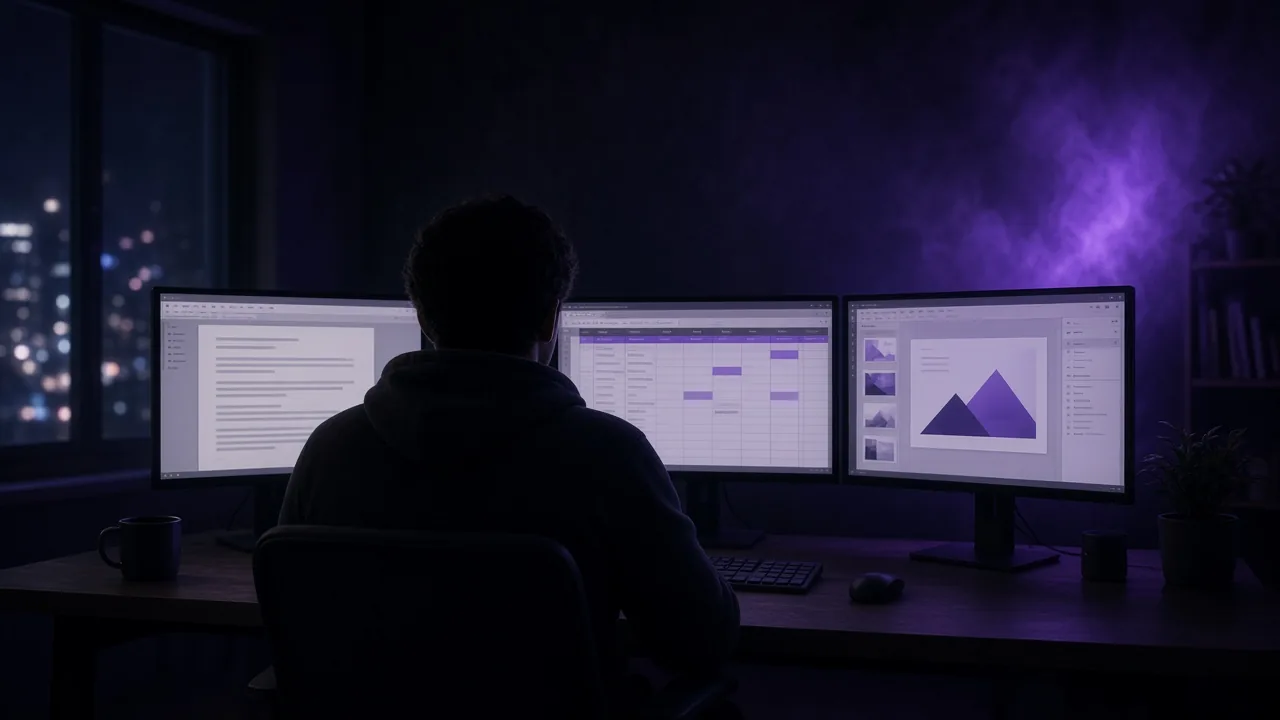
One Developer Used Claude to Clone Word, Excel and PowerPoint in Under Two Weeks — Microsoft Barely Blinked
WordCraft, GridCraft and DeckCraft look strikingly like Microsoft's apps, open real Office files, run offline and cost nothing. They were built with AI right after the same developer cloned Adobe's suite. Here is what they can do, why Microsoft stayed quiet, and what it means when software becomes cheap to copy.
Contents
- The stake
- From Adobe to Office in under two weeks
- What WordCraft, GridCraft and DeckCraft can do
- How they were built
- Built for AI agents, not just people
- The price tag they are aimed at
- Microsoft's response: almost nothing
- The irony everyone noticed
- Free alternatives already existed
- Would you trust AI-built software with your numbers
- The line Anthropic drew at games
- What it really takes to rebuild an app with AI
- Why this matters
- Should you switch
- Risks and counterpoints
- FAQ
- The bottom line
The stake
For decades, Microsoft Office has been one of the safest businesses in software. Word, Excel and PowerPoint are so familiar that "a Word doc" and "an Excel sheet" are generic terms.
Then, in October 2026, a single developer released free, open-source look-alikes of all three — built with help from an AI model, less than two weeks after he did the same thing to Adobe.
They are called WordCraft, GridCraft and DeckCraft. They open and save real Office files. They run offline on Windows, Mac, Linux and in a browser. And by their creator's own estimates, they are only about half to 60% ready for serious work.
The internet reacted the way it always does: half "game-changer," half "no job is safe," plus a flood of jokes about Microsoft getting a taste of its own AI medicine. Microsoft itself said almost nothing.
The real story is bigger than one project. It is about what happens when copying software becomes cheap.
From Adobe to Office in under two weeks
The developer is Brandon Thomas, a software engineer with about 15 years of experience, according to Tom's Hardware.
His first project, ArtCraft, made headlines earlier in October: free apps mirroring Adobe's Photoshop, Illustrator, Premiere and Lightroom. Decrypt reports he started it after Adobe charged him its cancellation fee one too many times, and built it with Anthropic's Claude Opus 5.5.
Critics called it vibe-coded "AI slop." Thomas pushed back on social media, pointing out that he knows how to code even if Claude did most of the typing on these projects.
Then, less than two weeks after the Adobe clones, he published the Office trio to the same ArtCraft GitHub. Tom's Hardware described the effort as part protest against subscription software. The project's community is already asking for more — a "CADcraft" to rival Autodesk tools comes up often.
What WordCraft, GridCraft and DeckCraft can do
According to Decrypt's review and the project's GitHub page:
WordCraft (the Word clone)
- Reads and writes .docx.
- Covers about 88% of the features in Word's ribbon.
- Already supports track changes, footnotes, citations and mail merge.
- About 91 MB, felt snappy and looked almost identical to Word in Decrypt's test.
- Labeled alpha; the team estimates it is about 60% of the way to replacing Word for real work.
- Had more than 12,000 GitHub stars at the time of Decrypt's report.
Still on the roadmap before beta: testing against real-world .docx files, charts and SmartArt that survive a save, page layout closer to Word's, a stability sweep and native printing.
GridCraft (the Excel clone)
- Handles 513 of Excel's 523 worksheet functions — SUM, VLOOKUP and nearly everything else.
- Covers about 89% of ribbon commands.
- Rated about 50% ready by its own developers. Compatibility with real-world .xlsx files is next.
In Decrypt's words: it knows almost every formula but may still trip over your company's budget spreadsheet.
DeckCraft (the PowerPoint clone)
- Covers about 79% of PowerPoint's features and 93% of the core ones.
- Opens and saves .pptx, runs transitions and animations, exports to PDF.
- Has not yet reached its first alpha.
The design is deliberately close to Microsoft's. That matters: familiarity is the main thing that keeps people from switching office software.
How they were built
A few technical choices stand out:
- Rust. The apps are written in Rust, a language known for speed and for preventing the memory bugs that crash software.
- One codebase everywhere. The same code runs natively on Windows, macOS, Linux and BSD, and inside a web browser.
- Clean-room approach. Thomas describes it as a clean-room rebuild: written from public file-format specifications and by observing how the originals behave, not by copying Microsoft's code. Decrypt compares this to how Compaq legally cloned IBM's PC BIOS in the 1980s.
- Permissive licenses. The code is under MIT and Apache 2.0, so anyone can read, modify and even reuse it commercially.
- Offline ownership. Tom's Hardware notes a key selling point: unlike browser-only suites, you own and run the software locally, without worrying it will one day demand a subscription.
The AI did a lot of the work. But the decisions — specs over copying, Rust, cross-platform, file compatibility — are classic senior engineering.
Built for AI agents, not just people
Here is the most forward-looking design choice. Every button in all three apps doubles as a command an AI agent can trigger.
They plug in through MCP, the Model Context Protocol, an open standard Anthropic created so AI models can operate tools. In practice, you could ask an AI to build a chart in a spreadsheet or reformat a report without touching the mouse.
That flips the usual relationship. Office suites added AI as a sidebar. These clones were designed from the start so AI can drive them.
The price tag they are aimed at
Microsoft charges $99.99 a year for Microsoft 365 Personal and $129.99 for the family plan, according to Decrypt. That is how most households get Word and Excel today.
Over time, what used to be a one-time purchase became a subscription bundle full of tools many people never use. That frustration is the emotional fuel behind the project — and behind a lot of the online jokes, which mostly boil down to: the one feature Microsoft keeps upgrading is the price.
A free look-alike that opens the same files is a direct shot at that bill.
Microsoft's response: almost nothing
So what did Microsoft do? Very little, as far as public reporting shows.
Coverage has not reported any legal threat or takedown. Accounts differ on whether the company acknowledged the project at all; at most, reports describe a brief acknowledgment with no further comment.
Silence is a reasonable strategy. Drawing attention would advertise the clones. And legally, a clean-room rebuild from public file formats is hard to attack.
But silence also highlights an awkward position. Microsoft spends heavily marketing how well AI can code — in every keynote and presentation. It cannot easily argue that AI-written software is untrustworthy while selling AI coding tools.
The irony everyone noticed
The jokes wrote themselves:
- Microsoft loves AI-built software — when it is Microsoft's. The company promotes AI coding constantly, then finds its flagship apps copied with AI.
- The "wrong" AI. The clones were built with Anthropic's Claude, not Microsoft's own Copilot.
- The joke about the joke. Satirists quickly imagined clones of the clones, since Apple's Pages already exists and every app now seems to spawn a copy.
Under the humor is a real competitive point: the AI that builds the best software may come from a company that does not sell the software it is copying.
Free alternatives already existed
Skeptics have a strong argument: free Office alternatives are nothing new.
- OpenOffice.org was born in October 2000 when Sun Microsystems released the code of its StarOffice suite.
- LibreOffice split off from it in 2010.
- Google Docs, Sheets and Slides are free in a browser.
- Linux has offered a free alternative to Windows for decades.
Microsoft Office sales survived all of them. Reddit commenters, as summarized by TechRadar, point exactly this out — and question whether one developer can keep up with bug fixes and upgrades.
Thomas, for his part, is blunt about the incumbents. "GIMP sucks," he said of the popular free image editor. "There is no reason to save broken software." He has also described LibreOffice killing a 40-page essay the week it was due.
What is genuinely new is speed. OpenOffice and LibreOffice took years of work by large communities. Thomas shipped three apps in under two weeks with an AI model. Even if the clones are rough, the cost of getting to "rough" has collapsed.
Would you trust AI-built software with your numbers
This is the most serious question in the debate.
Would you trust vibe-coded software with your financial spreadsheets, legal documents or a thesis due on Friday?
Reasons for caution:
- The developers say it is not ready. 50-60% readiness is their own estimate.
- File fidelity is hard. Opening a file is easy; preserving every chart, style and formula through a save is not.
- Support matters. Tom's Hardware commenters argued that businesses need support contracts, not just features.
- Overpromising. Decrypt notes Thomas already walked back a pledge to match Adobe's feature set within a month.
Reasons it may be fine for some uses:
- Open code can be inspected by anyone.
- Rust removes whole categories of crash bugs.
- Offline means your documents stay on your machine.
The fair verdict: great for experiments, personal documents and curiosity. Not yet for the budget, the contract or the dissertation without backups.
The line Anthropic drew at games
The Office clones arrived in the middle of a much wider AI cloning wave. Decrypt notes a developer got GTA V running natively on an iPhone, and modders threw Minecraft creepers at an Elden Ring boss.
Games hit a nerve. Indie studios began canceling public playtests out of fear someone would feed their demos into an AI tool and release a copy first. Tom's Hardware reports some bad actors used AI-completed versions of indie demos to blackmail developers.
So Anthropic acted. Around October 27, 2026, Claude Code's rules on Opus 5.5 gained a line telling it not to build "a recreation of a specific existing game, even if it is renamed or called original," according to Game Developer. Anthropic staff member Addy Osmani confirmed the change, saying using Claude to infringe IP is against its usage policy, while original games, genre games and games from your own designs and assets should keep working.
Developers complained it was blocking legitimate work. In early November, Anthropic adjusted it: you can now name a game to describe the mechanics you want, and Claude should build an original game in that genre; ask for a copy and it will offer something similar instead.
Notably, there is no comparable public rule against cloning productivity software. And as critics pointed out, anyone blocked by one AI can switch to open-weight models with no such limits.
What it really takes to rebuild an app with AI
"Vibe coding" makes it sound effortless: describe an app, get an app. The Office clones show a more realistic recipe.
- Start from a specification. Office file formats are publicly documented. That gives the AI something precise to implement against, instead of guessing.
- Pick a strong foundation. A fast, memory-safe language and a single cross-platform codebase avoid rewriting everything per operating system.
- Measure coverage. The team tracks hard numbers: 88% of Word's ribbon, 513 of 523 Excel functions, 93% of PowerPoint's core features. That turns a vague goal into a checklist the AI can work through.
- Test against reality. The roadmap's top items are real-world files, charts and layout fidelity. That is where clones usually fail, and where human judgment matters most.
- Ship early and in public. Alpha releases, open code and GitHub feedback create a test army for free.
- Have an experienced engineer in the loop. Fifteen years of experience is not a footnote. Knowing what to ask for, what to reject and how to structure a large codebase is what turns AI output into a product.
The lesson for anyone building with AI: the model can type faster than any team, but the scaffolding — specs, metrics, tests and taste — still comes from people. That is also why the gap between "looks like Word" and "replaces Word" is the hardest part of the journey.
Why this matters
Software moats are shrinking. If a skilled engineer plus AI can approximate a famous app in weeks, features alone protect no one. Trust, support, ecosystems, cloud services and file compatibility become the real moats.
Subscriptions face pressure. Every price increase now invites a free, AI-built alternative.
Clean-room rebuilds get cheap. Public file formats plus AI make legal reimplementation far faster.
Agent-ready design is the new baseline. Apps that expose every action to AI through open protocols may have an advantage over apps with an AI sidebar bolted on.
AI companies become IP gatekeepers. Anthropic's game rule shows model makers are now deciding what can and cannot be cloned.
Should you switch
- Curious individual: try WordCraft for everyday documents. Keep backups and test files you care about.
- Student: do not bet a final paper on alpha software. Save copies in another format too.
- Small business: experiment on non-critical work. Wait for beta and real-world file testing.
- Enterprise: stay put for now; evaluate the MCP automation angle as a pilot.
- Developer: study the architecture. Rust plus MCP plus clean-room specs is a template.
Risks and counterpoints
- Legal gray areas. Clean-room is a defense, not immunity. Close visual resemblance could still invite disputes.
- Maintenance burden. Office formats evolve. One developer and an AI may struggle to keep pace.
- Quality debt. AI-generated code at speed can hide bugs that surface later.
- Hype cycle. GitHub stars measure interest, not daily use.
- Incumbent response. Microsoft can cut prices, bundle more AI or improve compatibility — or simply wait.
FAQ
What are WordCraft, GridCraft and DeckCraft?
Free, open-source clones of Microsoft Word, Excel and PowerPoint, built by developer Brandon Thomas with help from Anthropic's Claude.
Are they safe to use for real work?
Their developers estimate WordCraft at about 60% and GridCraft at about 50% ready for real work, and DeckCraft has not reached alpha. Use them cautiously and keep backups.
Did Microsoft sue or respond?
No legal action has been reported, and coverage describes at most a brief acknowledgment.
Is cloning Office legal?
The project describes itself as a clean-room rebuild from public file-format specs, a historically recognized approach. Legal outcomes can still vary.
Will Claude refuse to help clone apps?
Anthropic added a rule against recreating specific existing games, later refined to offer original games in the same genre. No equivalent public rule for productivity apps has been reported.
The bottom line
A free, offline, AI-built Office look-alike will not end Microsoft 365 tomorrow. It is rough, unfinished and maintained by a tiny team.
But it proves something uncomfortable for every software company: the cost of building a credible copy has dropped from years of community effort to weeks of one engineer and an AI. When copying becomes cheap, features stop being a moat. Price, trust and service are what is left — and that is a much harder fight.
Sources
- Decrypt, Developer who cloned Photoshop with AI just did the same to Microsoft Office
- Tom's Hardware, Creator of free Adobe clones unveils open-source Office replications
- TechRadar, Developer who vibe-coded free Adobe clones reveals apps to take down Microsoft Office
- Game Developer, Anthropic orders AI tool Claude to stop remaking video games
- Tom's Hardware, Anthropic loosens Claude's game cloning ban

More stories you'll want to read
T3 Code12 minA full walkthrough of a modern multi-machine AI coding setup — local agents, remote boxes, and the glue that keeps context from falling apart.Read now →
 Claude repos12 minThe Claude ecosystem on GitHub is a flea market. After enough digging, the same patterns keep winning: skills, evals, repo maps, and guardrailed tool access.Read now →
 AI notes12 minNot every AI product needs a chatbot. A tiny capture device that listens, transcribes, and files thoughts can beat another app icon you will ignore.Read now →
 AI workflow12 minThe best AI coding walkthroughs are not model worship. They are assembly instructions for a week that still makes sense after the demo high fades.Read now →
 Claude Code12 minAfter enough hours, Claude Code stops being a novelty and becomes a set of scars: what to automate, what to never trust, and how to keep a repo healthy under agent speed.Read now →
 Eng fear12 minWhen a working engineer says a model output scared them, listen for the specifics. Usually it is not sentience. It is competence landing on a task that used to mark seniority.Read now →