 Office cloned11 minWordCraft, GridCraft and DeckCraft look strikingly like Microsoft's apps, open real Office files, run offline and cost nothing. They were built with AI right after the same developer cloned Adobe's suite. Here is what they can do, why Microsoft stayed quiet, and what it means when software becomes cheap to copy.Read now →
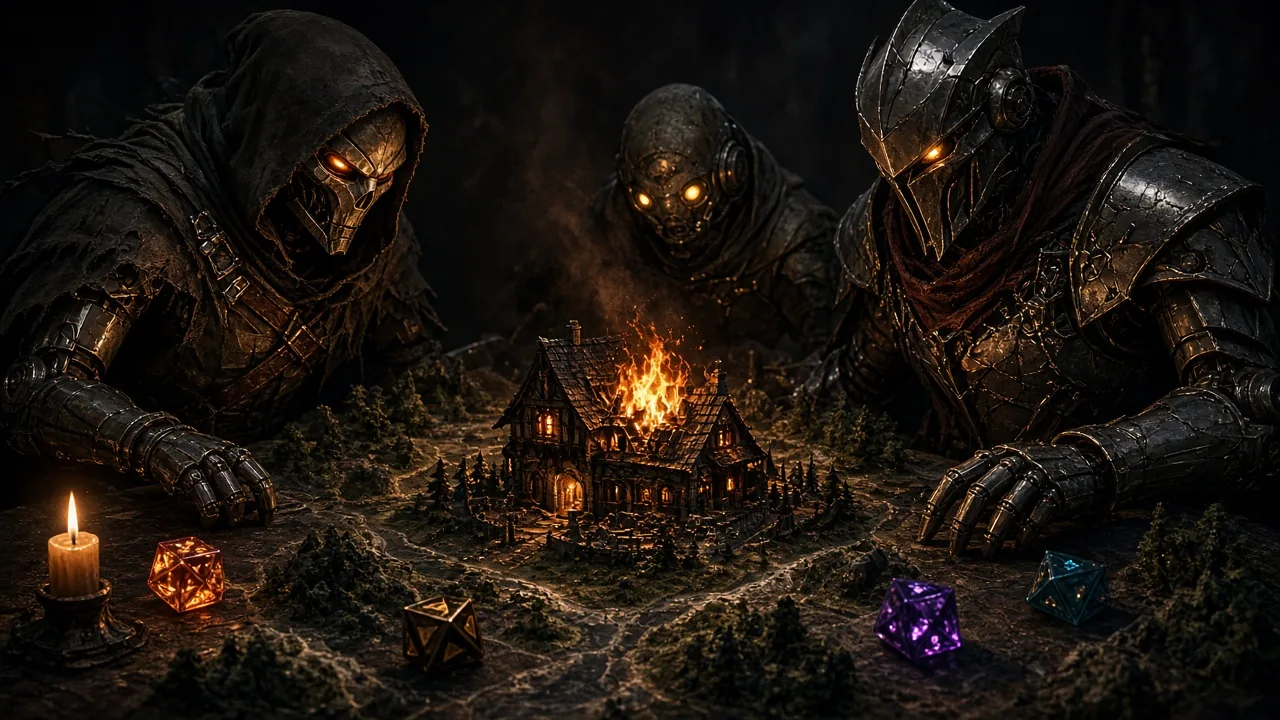
Three Unhinged AI Characters Played D&D With Permadeath — They Burned Down the First Tavern in Minutes
A movie-trailer tree, a succubus who turns into a frog when hit, and a furious Napoleon were given AI brains and sent through six D&D scenarios toward a final boss played by a live audience. The chaos was hilarious. The lessons about AI characters are serious.
Contents
- The stake
- Meet the three characters
- The rules of the campaign
- Scenario 1: the tavern of feuding wizards
- Scenario 2: the queen who needed a laugh
- Scenario 3: the museum with a locked door
- Scenario 4: the zombie who wanted a job
- Scenario 5: the kraken on the lake
- Scenario 6: the final boss is the audience
- What the chaos reveals about AI characters
- What researchers are finding
- Why this matters
- How to run your own AI party
- Risks and counterpoints
- FAQ
- The bottom line
The stake
What happens when you give AI characters wildly exaggerated personalities, hand them a Dungeons & Dragons campaign, and make death permanent?
You get a burning tavern within the first scene.
This is the story of a live, audience-driven experiment in which three AI-driven characters tried to survive six scenarios on the way to a final boss — played by the live audience itself. A human dungeon master narrated, rolled the dice and judged the outcomes. The AI characters decided what to do and said it out loud, in character, with synthetic voices.
It is very funny, often crude, and a surprisingly good window into how AI personas behave when you let them improvise. They commit. They escalate. They never break character. And they almost never do the sensible thing.
That tells us a lot about the future of AI in games, entertainment and even ordinary assistants.
Meet the three characters
This was the second campaign of its kind, so the characters were designed to be more extreme than before.
Spruce Lee
A living tree-creature (a treant) who wants to be an action movie star. He talks exclusively like the narrator of a summer blockbuster trailer — "In a world where…" — and ends his turns by shouting "Cinema!"
His once-per-day moves:
- Director's Cut: slash enemies with his branches.
- Arnold Throw: hurl someone across the room.
- Owl Attack: release the owls that, for some reason, live in his branches.
One of those owls, a chubby one nicknamed Fat Albert, became the audience's favorite character in the entire campaign.
Whimsy
A seductive succubus who charms enemies with a sultry voice. The twist: the moment she takes damage, she transforms into an extremely annoying frog version of herself.
Her moves:
- Mega Jump: fly or leap through the air.
- A healing dance to restore an ally.
- Charm: seduce an enemy into obeying her.
Napoleon Bonaparte
Simply the historical French emperor, inexplicably teleported into a fantasy world and furious at the British. He blames Wellington for everything, insists on his own tactical genius and rants about his height.
His moves:
- An ornate flintlock pistol, one shot per day.
- Summon three soldiers from his Grande Armée.
- A cheat move that lets him demand the dungeon master change the rules.
The rules of the campaign
The setup was a simplified version of D&D:
- Three hearts per character. Lose all three and you are permanently dead for the rest of the campaign.
- Dice decide outcomes. The dungeon master sets a target (say, 10 or above) and rolls.
- Six scenarios on a map leading north to the final destination, Obsidian Peak.
The story: the land had been trapped in a weekly time loop, repeating the same events over and over. The culprit, according to a wizard quest-giver, was the most repetitive force in existence — the stream's own chat, famous for repeating the same jokes endlessly. Defeat chat at Obsidian Peak and the loop breaks.
The characters' reactions to the quest set the tone. Spruce Lee announced it was "tree time." Whimsy flirted with the wizard. Napoleon called him an idiot, scribbled an insult on the wizard's forehead, and marched north anyway.
At the first fork in the road, Napoleon chose the middle path because "no enemy expects a frontal French assault," kicked over a road sign and rewrote it as "Napoleon's victory route."
Scenario 1: the tavern of feuding wizards
The party arrived at a huge snowy tavern where two wizards were screaming at each other, each accusing the other of breaking his wand. The barkeep offered his family's treasure to anyone who could stop them.
Then a stray spell missed and turned a gnome into a sheep.
Here is how the AI party handled it:
- Spruce Lee released his owls to harass both wizards. A strong roll meant the owls pecked them both for damage. Good start.
- One wizard fired back, missed, and set a piano on fire.
- Whimsy decided the solution was to break-dance kick a barrel of ale toward the burning piano. She succeeded. The magic ale exploded, the fire grew five times larger, and the whole corner of the tavern went up.
- Napoleon climbed on a table and gave a rousing speech that did not address the fire at all. He rolled a 1. The speech was so bad that the owls flew away in embarrassment.
- Another stray spell turned a patron into a cow.
- Spruce Lee tried to herd the cow and sheep into the wizards by throwing a table. He missed — and the table had Napoleon on it, who flew across the room and was dazed.
- Whimsy set a chair on fire and threw it at a wizard. She missed and hit one of Spruce Lee's owls, which flew around in a panic while burning.
Eventually Napoleon's once-a-day pistol shot finished one wizard. Then a third wizard burst in to steal the wands. Whimsy, by now in frog form, defeated him in a way best left undescribed in a family publication.
The party exited dramatically as the tavern burned. When the audience asked whether any tavern had ever survived these campaigns, the dungeon master admitted they basically always burn everything to the ground.
The scoreboard after scene one: the owls had done more useful damage than any of the main characters.
Scenario 2: the queen who needed a laugh
Next came a castle ruled by a king and an evil queen who desperately needed to laugh. Bad jokes would be punished by the guards.
This is a great test for AI characters, because humor on demand is hard.
- Spruce Lee tried slapstick: he shook his branches so an owl fell on his own face. The queen scowled. The king told him to get out.
- Whimsy told a mirror joke about laugh lines. The queen scowled again. "She's never disliked two bad jokes in a row," said the king — and ordered the guards to discipline her.
The AI characters stayed perfectly in character the whole time. They just were not funny to the queen. In a sense that is the joke: the personas were strong, but strong personality is not the same as good judgment about the audience.
Scenario 3: the museum with a locked door
In a blizzard, the party found a "Mountains Museum" run by a giant metal golem — curator, security guard and manager in one. He cheerfully explained he had not had visitors since he squashed a robber, insisted they stay for a few weeks, and then the front door locked behind them.
Napoleon's plan: use a magic swapping wand to swap the locked door with the golem. It sort of worked, in the way these things work.
By the end, the golem's visor flashed red and it announced a self-destruct sequence. Spruce Lee, trapped, made the most cinematic choice possible: he ripped off his own arms to escape through the gap, then walked away from the explosion in slow motion — refusing to look back, because cool guys never look at explosions.
That arm sacrifice became a running continuity detail. The dungeon master later reminded him he could no longer pick anything up.
Scenario 4: the zombie who wanted a job
In a bustling desert tavern full of odd characters — a fisherman, a walrus man, a bard, a resentful goblin — a zombie named Slob shuffled up to the party. He promised he did not want to eat brains. He just wanted to be an upstanding member of society with a job.
There was a fishing mini-game. Napoleon flung a fishing hook at a cup on a sack of flour and barely missed; the walrus man asked whether he was used to firing artillery. Spruce Lee — armless — sent Fat Albert the owl to grab the cup instead.
Then a zombie hunter named Zod burst in, crossbow aimed at Slob's head, declaring zombies contribute nothing to society.
Spruce Lee announced that bigotry ends here and unleashed his owls. Fed and rested, Fat Albert attacked with advantage, rolled perfectly and pecked Zod in the head. Zod's one weakness, it turned out, was owls. He fled screaming into the wilderness.
A grateful Slob asked how he could repay the kindness. It was the most genuinely heroic moment of the campaign, and it came from the character who mostly talked about movies.
Scenario 5: the kraken on the lake
Between the party and Obsidian Peak lay a huge lake. A sea captain offered passage for five gold pieces each — most of their net worth.
Hours into the trip, something slammed into the hull. Sea monsters. Then a kraken rose from below and slammed tentacles onto the deck.
Highlights:
- Spruce Lee chose to power up by eating seagull droppings off the deck. It was technically a healing move. Everyone was horrified.
- The kraken smashed him down to two hearts.
- Napoleon leapt onto a broken cannon to rally the sailors "like Waterloo, only this time we win." His allies did not speak French. The rally failed. A tentacle launched him across the ship.
They made it across, battered, to the base of Obsidian Peak.
Scenario 6: the final boss is the audience
At the summit, beyond a bridge and between pools of lava, stood a hideous creature: Twitch Chat, the audience itself, given a body. Behind it glowed a massive purple orb.
This is the clever part of the design. The final boss's actions were written by the live audience. Their messages became its moves.
The audience opened by splitting Whimsy into two separate beings — "Sexy Whimsy" and "Ugly Whimsy" — and tried to throw the frog half into a volcano. Then the boss split into four smaller chatters, nicknamed by the first four messages on screen.
The battle that followed:
- Napoleon fired his pistol at the south chatter. A 19. The chatter lost its head.
- The audience retaliated by turning Fat Albert into a giant demonic bald eagle that spat lava and dive-bombed Napoleon toward the fiery pits.
- Napoleon summoned his three Grande Armée soldiers, whose only achievement in the whole campaign had been removing a zombie's arms. They missed.
- Whimsy charmed the western chatter to her side.
- The orb began whispering to Whimsy: touch me and take the time power.
She touched it. Her wish: control over Twitch Chat, "helplessly charmed, dancing obediently." The roll succeeded. All four chatters were seduced. Her first command was a victory dance — which the audience described, gleefully, as dancing straight into the lava.
Then the orb called to the survivors. In the end, only Spruce Lee remained. The audience, now holding the orb's power, decided his fate: he fused with Fat Albert into the ultimate cinematic god, conquered Hollywood, won an absurd number of awards, became president of the solar system — and then, in one final movie moment, walked into the lava with a thumbs-up.
The loop was broken. Cinema.
What the chaos reveals about AI characters
Strip away the jokes and several real patterns show up.
1. Personas are sticky
Every character stayed in voice for nearly two hours. Spruce Lee never once stopped narrating his own trailer. Napoleon blamed the British in every scene. Modern language models are extremely good at holding a persona when it is clearly defined.
2. Strong persona beats good judgment
Whimsy kicked alcohol into a fire because that is what a chaos-loving succubus would do. Napoleon gave speeches instead of fighting fires. When you tell a model to be a character, it optimizes for being that character, not for winning.
3. AI improv escalates
Almost every AI action raised the stakes: more fire, more animals, more explosions. Models trained to be engaging seem to reach for drama. That is great for comedy and risky anywhere else.
4. The human is the guardrail
The dungeon master constantly shaped outcomes: setting difficulty, interpreting wild actions, telling one character to stop repeating a catchphrase, steering away from content that could get the show in trouble. The AI provided energy; the human provided structure.
5. Randomness makes AI feel alive
Dice did a lot of the storytelling. A natural 1 turned a speech into a disaster; a 19 turned a pistol shot into a legend. Pairing AI choices with real randomness makes outcomes feel earned instead of scripted.
6. The audience is part of the system
Making live chat the final boss turned spectators into players. That is a design pattern you will see more of: AI characters plus crowd input plus a human host.
What researchers are finding
This is not just entertainment. Researchers are now using D&D as a serious test for AI agents.
A team led by UC San Diego presented work at NeurIPS 2025 that had language models play D&D combat as players, monsters and dungeon masters, paired with a rules engine that acted as a guardrail against hallucination. The models played 27 scenarios against each other and against more than 2,000 experienced human players.
Their findings echo the campaign:
- In their tests, Claude 3.5 Haiku was the most reliable, with GPT-4 close behind and DeepSeek-V3 trailing.
- The models developed personality mid-fight: goblins started taunting ("Heh — shiny man's gonna bleed!"), paladins made heroic speeches for no reason while stepping into danger, and warlocks got dramatic in mundane situations.
- Staying in character was one of the things measured, along with choosing correct actions and tracking resources.
The researchers' point is that D&D's long campaigns, strict rules and teamwork make it a natural benchmark for agents that must work over long periods — the same skills needed for business planning or multiparty negotiation. Other projects are testing language models as fully automated game masters.
In other words, Napoleon's pointless speeches are not a bug unique to one campaign. They are a known behavior of language models placed in role-play.
Why this matters
For games: AI characters that can improvise in voice, react to dice and respond to an audience are close to ready for interactive entertainment. Expect AI party members, AI villains and audience-driven bosses.
For live entertainment: formats that combine a human host, AI performers and live chat are a new kind of show. The human keeps it watchable and safe.
For AI assistants: the same tendencies — commit to the persona, escalate for engagement — exist in serious products. A bot told to be "fun" or "bold" will take that literally.
For AI evaluation: role-play is becoming a legitimate benchmark for long-horizon behavior.
How to run your own AI party
- Write sharp personas. A goal, a voice, two or three quirks and a weakness.
- Give limited powers. Once-per-day moves force decisions and create drama.
- Keep dice and rules outside the AI. Let the model propose actions; let a rules engine or a human judge outcomes.
- Use a human or system moderator. Someone has to say no.
- Add consequences. Permadeath makes every choice matter.
- Let the audience in carefully, with filters.
- Expect escalation and design scenes that can absorb it.
Risks and counterpoints
- Content risk. Personas built to be edgy can drift into offensive territory fast. This campaign leaned heavily on crude humor, and the host repeatedly worried about crossing platform rules.
- Repetition. Even the host predicted the audience would tire of the catchphrases. Strong personas can become one-note.
- Not real strategy. The characters were entertaining, not competent. Do not mistake persona fidelity for intelligence.
- Human dependency. Without a skilled dungeon master, the same AI chaos could be unwatchable.
- Crowd control. Letting an audience drive a boss is fun, but it needs moderation.
FAQ
Did the AI characters really decide their own actions?
Yes. Each AI character chose and voiced its actions in character. A human dungeon master narrated, set difficulty and rolled dice.
Did anyone survive?
Spruce Lee was the last one standing at the end — and then, by the audience's decree, walked into the lava in a final cinematic moment.
Who was the final boss?
The live audience, personified as a creature called Twitch Chat, whose actions were written from viewer messages.
Is D&D actually used to test AI?
Yes. Researchers at UC San Diego and elsewhere use D&D simulations to measure long-term planning, rule following and staying in character.
Why do AI characters keep doing dramatic things?
Models told to play a character optimize for that character and for engaging output. Research has observed the same "heroic speech for no reason" behavior.
The bottom line
A movie-trailer tree, a frog-shifting succubus and an angry Napoleon burned a tavern, failed comedy, blew up a museum, saved a zombie, survived a kraken and defeated a boss made of their own audience.
It was ridiculous. It was also a clean demonstration of what AI characters are like today: tireless, committed, dramatic and terrible at restraint. Give them rules, dice and a good human at the table, and you get something new — not a scripted game, not a chatbot, but an improvised story that nobody could have written in advance. That is the real future of AI in play.
Sources

More stories you'll want to read
Office cloned11 minWordCraft, GridCraft and DeckCraft look strikingly like Microsoft's apps, open real Office files, run offline and cost nothing. They were built with AI right after the same developer cloned Adobe's suite. Here is what they can do, why Microsoft stayed quiet, and what it means when software becomes cheap to copy.Read now →
 Genie 411 minDescribe a scene and seconds later you are walking through it, hearing birds, steering a character and arguing with people inside it. Google DeepMind's Genie 4 adds native audio, interactive dialogue and an AI director that keeps the world coherent. Here is what it does, how it works and what it still cannot do.Read now →
 Pocket AI11 minA cheeky assistant small enough to hold between two fingers answered questions, controlled smart lights and insisted it was "compact," not small. Here is how a cheap microcontroller pulls that off, what open-source firmware makes it possible, and what to know before you build one.Read now →
 AI + VR12 minSpeak a teddy bear into existence in under two minutes. Rehearse surgery with a tutor that adapts. Walk through a house that rearranges itself for you. AI is quietly becoming the engine of virtual reality — and the headset is becoming the most intimate data sensor you own.Read now →
 AI in the lab13 minForget chatbots. In one week, AI learned to simulate the whole planet's storms at 5 km, plan chemistry experiments, steer real robots after training only in simulation, and exploit 948 Linux bugs. Here is what actually shipped, what is hype, and why it matters.Read now →
 GPT-5.4 tested14 minA digital-twin planet, a 32-bar piano opus, recursive ray-traced reflections and a full platformer game — GPT-5.4 cleared tests most models fail. It also made ugly slides, missed tumors and posted an eye-watering hallucination score. Here is the whole picture.Read now →