 Micro robots12 minFlashy micro-robot demos from NVIDIA events are easy to meme. Underneath is a serious pitch: simulation, foundation models, and platforms that make robot learning less bespoke.Read now →
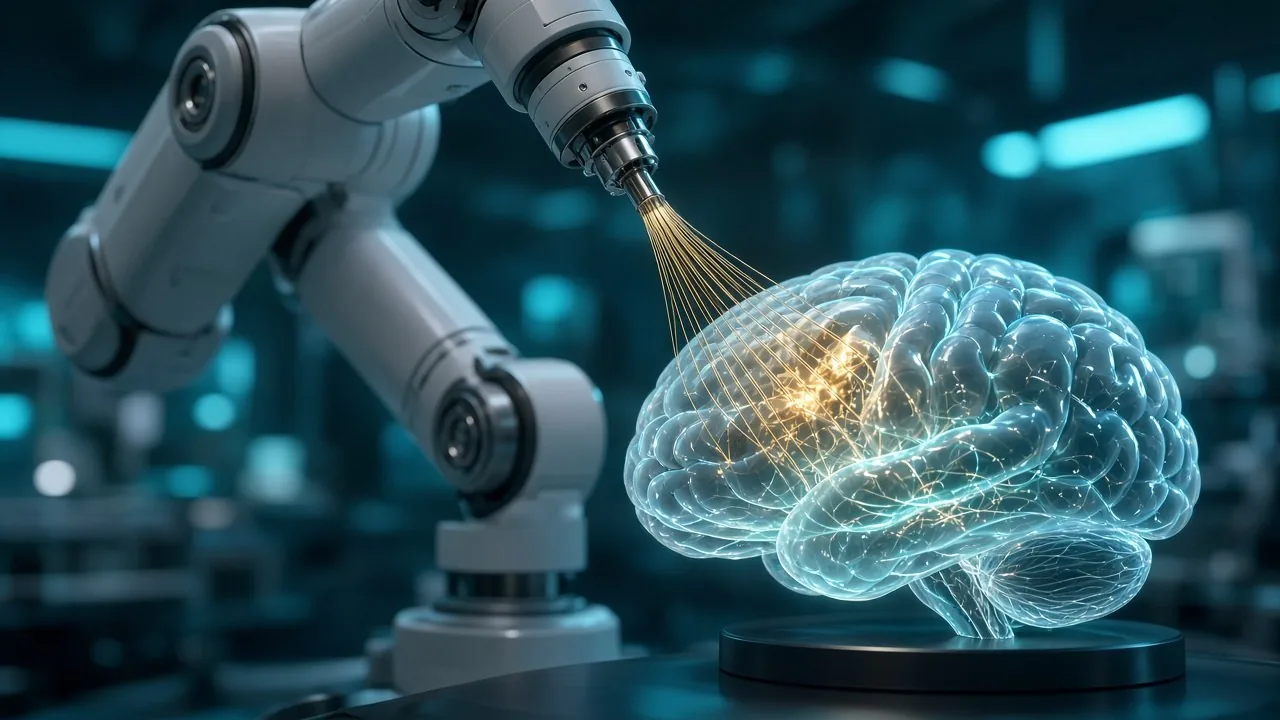
Neuralink's Robot Stitches a Thread Into the Brain Every 1.5 Seconds — But the Chip Still Can't Read Your Thoughts
Inside the clean room, the 3D-printed practice head and the surgical robot that threads over a thousand electrodes into living tissue. Brain chips are real, in humans, and moving fast. What they actually do is stranger — and more hopeful — than mind reading.
Advertisement
Contents
- A robot that does brain surgery
- Your brain, in your hands
- The motor cortex and the "hand knob"
- Lip reading, not mind reading
- The stadium problem: four ways in
- Inside the Link
- The clean room and the heat problem
- The R1 robot, up close
- Reading out vs writing in
- What brain chips do today
- Where things stand in 2026
- Why this matters
- What to watch next
- Risks and counterpoints
- FAQ
- The bottom line
A robot that does brain surgery
A robotic arm hovers over a model of a human head. A needle finer than a hair grabs a thread of electrodes and sinks it into brain tissue. Then the next. Then the next.
Each insertion takes about 1.5 seconds.
This is Neuralink's next-generation R1 surgical robot, and its job is exactly what it sounds like: putting a computer chip inside a human brain. It sounds like science fiction. It is not anymore. Human clinical trials are under way, the technology is improving quickly, and some of the people building it openly talk about making humans superhuman — seeing in infrared or radar like Geordi La Forge in Star Trek.
But the most important story here is not about turning people into machines. It is about something closer to the opposite: using machines to give people back abilities they lost.
Advertisement
Here is how brain chips actually work, how the competing approaches stack up, what you can and cannot do with one, and where the field stands as of late 2026.
Your brain, in your hands
Before any chip, you need a map. The first step for a brain implant is a detailed brain scan.
It helps to know what you are dealing with. A human brain weighs about as much as a supermarket chicken. Held in your hands, people describe it as squishy, firmer than expected, something like the inside of a kiwi or a mango. And in a living person, it moves: about a fifth of the blood from every heartbeat goes to the brain, so it pulses.
The popular analogy is that the brain is a computer. At first, that works. Both are processors: input in, output out. You press a key and a computer processes it and updates the screen. You see a cup about to fall and your brain processes that and tells your arm to catch it.
But if the brain is a computer, it is the most complicated one ever encountered. There are more connections inside it than there are galaxies in the observable universe.
The motor cortex and the "hand knob"
More than 200 years ago, scientists discovered that the brain communicates using electrical signals. Those messages travel through the body along nerve pathways — think of them as superhighways.
You can watch this in a functional brain scan. When you try to move your hand, a rush of oxygenated blood lights up one part of the brain. That fuels neurons, which fire electrical and chemical signals cell to cell, down the spine, out the arm, to the hand: move.
The wiring is crossed. Move your left hand and the signal appears on the right side of the brain, and vice versa.
Every brain's folds are unique — a kind of brain fingerprint. But where the brain handles particular jobs is broadly consistent between people. Vision, speech and movement each have their regions.
One small region matters more than any other for today's implants. Inside the motor cortex is an area neuroscientists call the "hand knob." That is where Neuralink's team says it wants to place threads to record motor intent. Find a person's hand knob on their scan, and you know where the implant goes.
Lip reading, not mind reading
This is the single most misunderstood point about brain chips.
The fear is that they will read your thoughts. That is not how current brain-computer interfaces (BCIs) work. They read your intention to move.
When your brain sends a signal to move your hand, it feels instant. It is not. It takes time to travel from where intention starts, in the brain, to where the action happens, in the hand. A BCI listens to the signal along that highway — after the thought, but before the action.
So it cannot pull your dog's name out of your memory. But if you are trying to say your dog's name, it can pick up the signals on their way to your mouth.
One researcher's phrase for this is perfect: it is like "neural lip reading." Lip reading, not mind reading. The message is already being sent. The BCI's job is to reroute where it goes.
From USB-C to wireless
The hardware has changed fast. Neuralink's early research version used a wire — a standard USB-C connector going through the skin. Engineers described plugging it in to download data and feeling like they were in The Matrix. That version dates to roughly 2018 to 2019.
Today's implant transmits wirelessly over Bluetooth.
The stadium problem: four ways in
What you can read depends on where you put the sensor — and how invasive you are willing to be. The best analogy is a sports stadium.
Option 1: the blimp (EEG on the scalp)
Electrodes placed on the outside of the head have been used for decades and still are. But it is like flying a blimp over a stadium trying to work out what game is being played. You can hear the general boos and cheers, but you cannot see the plays.
Trade-off: no surgery, very low detail.
Option 2: the nosebleeds (Synchron)
Synchron avoids open brain surgery. Its Stentrode is delivered through a vein in the neck and sits inside a blood vessel above the motor cortex. Now you are inside the stadium — but in the cheap seats.
Trade-off: minimally invasive, better signal than the scalp, still distant from individual neurons. Synchron has been preparing a pivotal trial in 2026 aimed at a full FDA approval filing.
Option 3: courtside (Precision Neuroscience)
Precision Neuroscience places a thin film with tiny platinum electrodes on the surface of the brain. The device is about the size of a postage stamp and goes in through a small slit in the skull. That is brain surgery, but you are close to the field with a wide view.
Trade-off: more invasive, much richer signal across a broad area. In 2025, Precision received FDA 510(k) clearance for its Layer 7-T cortical electrode array for temporary use of up to 30 days — not for a permanent implant.
Option 4: in the huddle (penetrating electrodes)
To hear individual players, you need microphones inside the huddle — electrodes that go into brain tissue.
The veteran here is the Utah Array, a small grid of rigid metal-and-silicon spikes used in humans since 2004. It can detect individual neurons firing, which makes it extremely precise. Its weakness is stiffness: the brain moves, the array does not, and that mismatch causes scarring over time.
Neuralink wanted the huddle-level signal without the rigidity. That is the whole design philosophy behind its implant.
Inside the Link
Neuralink's implant is called the N1, or "the Link." Under a microscope, its business end is a spray of ultra-thin, flexible threads — hundreds of them, designed to move with the brain rather than against it.
Key details:
- The part that enters the brain is only about 4 to 5 millimeters deep.
- Each thread is dotted with electrodes — the "microphones."
- Together they total more than 1,000 electrodes listening to neural chatter.
- Onboard electronics amplify, process and filter the signals to the frequency band of interest.
- The processed data goes out wirelessly via Bluetooth.
When everything is in place, the implant sits flush with the skull, covered by skin, invisible from outside.
The clean room and the heat problem
The brain is amazing, but it is a hostile place for electronics. It does not want a computer chip inside it.
Neuralink assembles and tests its implants in a clean room. Visitors suit up head to toe — "full bunny," in the engineers' phrase. The point is not to protect people from the chips. It is to protect the chips from people.
Two engineering problems dominate:
- Heat. You don't much care if your phone warms up on a charging pad. An implant warming brain tissue is a different matter, so power and charging have to be tightly managed.
- Leaks. Nothing can leak out of the device, and nothing can leak in. Every unit must be built and tested to be as brain-friendly as possible.
The R1 robot, up close
Because the threads are so tiny and flexible, engineers say it would be impossible for a human surgeon to handle and place them by hand. So Neuralink built a robot.
Practice happens on an uncomfortably realistic 3D-printed head whose brain is modeled on a real person's scans.
The next-generation R1 works like this:
- Special cameras map the brain's surface where the implant will go.
- Extra sensors update that map in real time, tracking the tiny blood vessels on the surface.
- A very fine needle grabs one thread and inserts it, avoiding the vessels.
- It repeats, about 1.5 seconds per thread.
Published accounts of Neuralink's updates say the original robot took about 17 seconds per thread, and that the newer approach uses multiple cameras plus optical coherence tomography and is designed to insert through the dura — the protective membrane around the brain — rather than removing it, reducing invasiveness. A surgeon still opens the skull and aligns the brain to the robot.
Reading out vs writing in
Ask people what they would want from a brain chip, and two dreams come up.
Dream 1: control things with your mind
Think of the movie Matilda: sending signals out to control a computer, a robot, anything. This one is already happening — it is the neural lip reading described above.
Dream 2: put information back in
The Matrix moment where Neo downloads kung fu. New senses, like seeing in radar. Entirely new experiences.
This is vastly harder. Researchers in the field say we are "very far" from that version, though it hints at where progress might head.
Here is why. Reading out is like riding an existing highway. Writing in is like building a new one. A Matrix-style experience would require covering almost the entire brain, reading every output at once, and writing back a completely different reality than your body is experiencing — smells, touch, everything that makes up reality.
And this is where the computer analogy breaks. A computer separates memory and processing. The brain intertwines them, constantly learning and rewiring based on everything you have ever experienced. If you fed it something genuinely new, like radar, nobody knows what that would feel like.
Not impossible. Just far.
What brain chips do today
So for now, the field focuses on reading the motor cortex. Using implants, people today can:
- Convert intended speech into words, spoken by a computer.
- Move cursors and use computers.
- Play video games.
- Control robotic arms.
Better input would make these much richer. Researchers point to the Star Wars scene where Luke Skywalker's prosthetic hand is touched on each fingertip and he feels it. Adding touch feedback to prosthetics is an explicit goal.
The deeper point is about who this is for. Imagine seeing a cup fall, your brain sending the signal to grab it — and the signal being blocked. That is daily life with paralysis. Imagine knowing exactly what you want to say, your brain firing the signal to your mouth — and nothing coming out. That is often the reality of ALS.
Brain-computer interfaces are building bridges over broken highways:
- Reading the motor cortex and sending signals to stimulators elsewhere in the body to help people with paralysis walk again.
- Implants in the visual cortex, paired with camera glasses, aiming to restore vision in blind people.
- Reading the signals meant for the mouth and giving people their voice back — "I'm talking to you with my mind."
They are not hijacking the highway. They are restoring autonomy.
Where things stand in 2026
The pace has picked up considerably. Based on Neuralink's own updates and reporting this year:
- Participants: Neuralink says it has 21 people enrolled in its "Telepathy" trials worldwide, up from three in 2024. Most have paralysis and use the implant to type, browse and control devices.
- Safety record: the company says it has had zero serious device-related adverse events so far. That is a company claim, not an independent review.
- More electrodes: Neuralink says it is moving from about 1,000 to 3,000 electrodes in its next implant, with Musk describing roughly three times the capability, targeted for late 2026 subject to testing and approval.
- Blindsight: Neuralink's vision implant, which would stimulate the visual cortex from an external camera, received FDA Breakthrough Device designation in September 2024. Musk has said it is ready from an engineering standpoint and waiting on regulatory approval. Reporting as of October 2026 found no published human implant.
Competitors are moving too: Synchron toward a pivotal trial, Precision with a cleared temporary electrode array, and academic groups with Utah Array–based speech decoders that have produced some of the most striking results in the field.
Why this matters
It reframes the "cyborg" fear
The loudest public debate about brain chips is about superhuman augmentation and mind reading. The actual near-term work is restorative medicine: communication for people who cannot speak, control for people who cannot move.
It is a robotics story as much as a neuroscience one
Neuralink's bet is that precise, automated insertion — a robot placing thousands of electrodes safely — is what makes high-bandwidth implants scalable. If surgery can become fast and standardized, these devices can reach far more people.
AI is the decoder
Turning noisy neural signals into cursor movement or words depends on machine-learning models trained on each person's brain activity. Better AI means better decoding, which means more useful implants from the same hardware.
What to watch next
- Electrode count. Does the jump to about 3,000 channels translate into visibly better control?
- Durability. Do the flexible threads keep their signal for years? Neuralink says it is working on thread retention.
- Blindsight's first human. Regulatory clearance and early results will show whether "writing in" can work at useful resolution.
- Pivotal trials. Synchron's path to a full FDA approval will set precedents for the whole industry.
- Insurance and cost. A device that works but cannot be paid for helps no one.
Risks and counterpoints
- Brain surgery is brain surgery. Infection, bleeding and inflammation are real risks, and long-term effects of implants over decades are not fully known.
- Company claims need independent confirmation. Many figures in this field — participant counts, safety records, capability multiples — come from companies themselves or their founders' posts.
- Timelines slip. Musk said in mid-2025 that first vision implants would come within six to 12 months. That window has passed without a confirmed human implant.
- Neural data is the most private data there is. As devices improve, questions about who owns and protects brain signals will matter enormously.
- Hype can harm patients. Overpromising superhuman features can distract from — and raise false hopes about — the genuinely life-changing medical uses.
FAQ
Can Neuralink read my thoughts?
No. Current implants read signals related to intended movement or speech in specific brain regions, not memories or private thoughts. Researchers describe it as "neural lip reading."
How many people have a Neuralink implant?
Neuralink says 21 participants are enrolled in its trials worldwide as of its latest update.
How is Neuralink different from Synchron?
Synchron's Stentrode is placed through a blood vessel without open brain surgery, but sits farther from neurons. Neuralink's threads go into brain tissue for a higher-resolution signal and require surgery.
What does the R1 robot do?
It maps the brain surface, tracks blood vessels in real time and inserts each ultra-thin electrode thread, about 1.5 seconds per thread in the latest version, according to Neuralink-related reporting.
Will brain chips restore sight?
That is the goal of Neuralink's Blindsight and other visual-cortex projects. Blindsight has Breakthrough Device designation but, as of October 2026 reporting, no published human implant.
The bottom line
Brain chips are no longer a thought experiment. A robot can thread over a thousand electrodes into a living brain, one every 1.5 seconds, and people with paralysis are using those implants to type, play and talk.
What they do is not mind reading and not The Matrix. It is quieter and more important: catching the signal on its way down a broken highway and building a bridge to where it was meant to go. The sci-fi version may come someday. The real version is already giving people back their independence.
Sources
- Neuralink, Two Years of Telepathy
- IBTimes UK, Musk announces Neuralink with 3X capability, teases Blindsight
- Precision Neuroscience, FDA clearance for high-resolution cortical electrode array
- U.S. FDA, 510(k) K242618 Layer 7-T decision letter
- The Robotics Media, Synchron preps 2026 Stentrode pivotal trial
More stories you'll want to read
Micro robots12 minFlashy micro-robot demos from NVIDIA events are easy to meme. Underneath is a serious pitch: simulation, foundation models, and platforms that make robot learning less bespoke.Read now →
 Computers that eat14 minA server rack in Singapore runs on lab-grown human neurons that must be fed every three days. Amazon is selling AI built from neuron experiments. Here's what these living computers actually do, where the 'million times more efficient' claim comes from, and the consent question nobody asked donors.Read now →
 The week AI broke scale15 minIn five days, the AI industry saw a leadership crisis at its most valuable chipmaker, one of the biggest IPOs ever set its price range, and three frontier labs ship or tease new models. Here is every story that matters, what is confirmed, and what is still rumor.Read now →
 Fable 5.2 unpacked13 minAnthropic's Claude Fable 5.2 tops the leaderboards, built a bootable operating system with 1,000 subagents and controlled real robot arms. It also costs more per task than almost anything else. Here is what the benchmarks, the price war and the safety caps actually mean.Read now →
 Genie 411 minDescribe a scene and seconds later you are walking through it, hearing birds, steering a character and arguing with people inside it. Google DeepMind's Genie 4 adds native audio, interactive dialogue and an AI director that keeps the world coherent. Here is what it does, how it works and what it still cannot do.Read now →
 Ground stop12 minA rare nationwide ground stop hit three days after the FAA's new $875 million AI routing tool went live in all 22 en-route centers. The internet pointed at the AI. The FAA's own account points at a router in Arkansas and 40-year-old copper. Here's what actually broke, and why the suspicion still matters.Read now →