 Musk on post-work AI14 minCurrency measured in watts and tons. An economy a million times bigger than Earth's. A weekly safety call between rival AI labs. And a startling admission that maybe Larry Page was right. Here is Musk's full vision, what is verifiable, and where it breaks down.Read now →
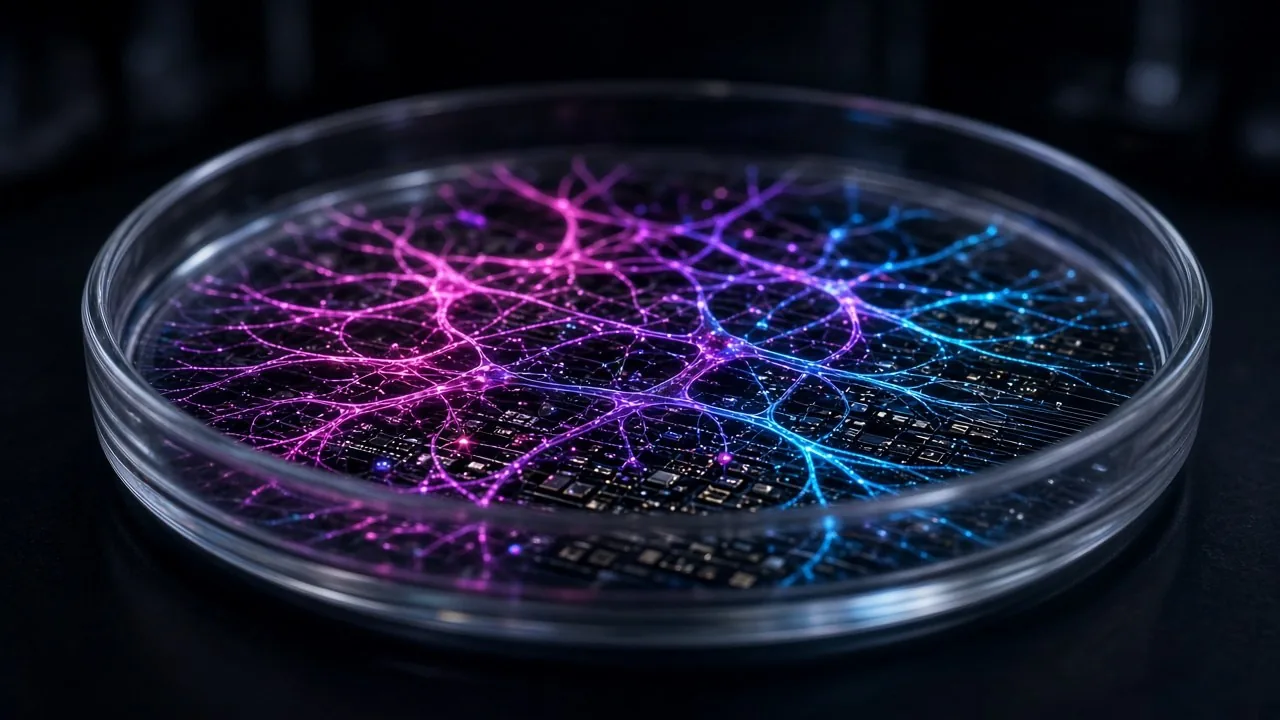
You Can Rent a Computer Made of Living Human Brain Cells for $2,200 a Month. Here's What It Can Really Do
A server rack in Singapore runs on lab-grown human neurons that must be fed every three days. Amazon is selling AI built from neuron experiments. Here's what these living computers actually do, where the 'million times more efficient' claim comes from, and the consent question nobody asked donors.
Advertisement
Every three days, a technician in Singapore walks up to a server rack and feeds it.
Not a metaphor. The rack gets a cocktail of sugar, micronutrients and pH buffers. A gas mixer pumps in oxygen, carbon dioxide and nitrogen, because the things inside it breathe. If the room got as cold as a normal data centre, the computers would die.
They are living human brain cells, grown on silicon chips. You can rent one for about $2,200 a month or buy one outright. And in September, Amazon Web Services started distributing an AI product that was built by watching neurons respond to images.
That sounds like the start of a sci-fi movie. The real story is stranger, more limited, and in some ways more interesting. Here's what these machines are, what they can genuinely do, where the boldest claims come from, and the uncomfortable question of whose cells are inside them.
Advertisement
The data centre with a pulse
Inside the Centre for Life Sciences at the National University of Singapore sits a rack of 20 units that looks, from a few metres away, like any other piece of server-room hardware.
It went live on July 16, 2026. It is a joint research project between three partners:
- Cortical Labs, the Melbourne biotech that makes the units, called CL1s.
- NUS Medicine, where neuroscience professor Rickie Patani oversees the facility.
- DayOne, a data centre operator that builds conventional facilities across Asia.
According to The Straits Times, each CL1 holds at least 200,000 lab-grown neurons sitting on an electrode-fitted silicon chip. The neurons were derived from blood cells that were reprogrammed into stem cells and then coaxed into becoming brain cells.
The plan, if it passes regulatory approval plus energy efficiency and safety tests, is to grow the Singapore installation to as many as 1,000 units. That expansion is a conditional goal, not a done deal.
Why a data centre company cares
Cortical Labs' founder and CEO, Chong Hon Weng, pitches biological computing for a specific niche: problems where data is scarce and conditions keep changing. His examples are humanoid robots operating in messy homes and offices, and cybersecurity systems spotting anomalies without huge training sets.
The power numbers are the other half of the pitch. Chong says each CL1 runs at about 30 watts, life support included. For comparison, a single Nvidia H100 SXM can draw up to 700 watts under heavy load, and an eight-GPU server can draw roughly 10,200 watts.
Singapore knows exactly why that matters. Its data centres were consuming about 5.3% of the country's electricity in 2019, rising to 7% in 2020, and the government imposed a temporary pause on new data centre construction starting in 2019.
You can actually buy one
This is no longer a lab-only curiosity. Cortical Labs sells the CL1 commercially.
- Buy: around $35,000 per unit, dropping to about $20,000 per unit in rack configurations, according to TechSpot.
- Rent: about $2,200 a month for remote access to one CL1, according to The Straits Times. Chong frames that as roughly half the $4,300 monthly cost of renting a high-end AI chip from a major cloud.
- Scale: the Melbourne facility runs 120 CL1s and has around 20 paying customers, mostly corporate research arms and universities experimenting with robotics and gaming.
Customers do not touch the cells. They log in remotely and write ordinary code. Cortical Labs built an operating system it calls biOS that sends electrical stimulation patterns into the tissue through the electrode array and reads back how the neurons fire. Software on the silicon side translates those spikes into something useful.
Every computer has an expiry date
Nothing in the rack lives forever. Cortical Labs says the neurons stay viable for up to about six months in their sealed life-support chamber, which controls gas, temperature and waste filtration.
When a culture dies, whatever it "learned" dies with it. The chip is cleared and a new batch is grown. Imagine a GPU that had to be re-manufactured twice a year and forgot everything each time. That is the operating reality.
How you grow a computer from a blood sample
The whole field rests on one discovery.
In 2006, Shinya Yamanaka's team at Kyoto University showed that adding a small set of genes could turn an ordinary adult cell back into a pluripotent stem cell, a blank cell able to become almost any tissue. Yamanaka shared the 2012 Nobel Prize in Physiology or Medicine for it. These are called induced pluripotent stem cells, or iPSCs.
From there, the recipe looks like this:
- Start with an ordinary sample. A little skin or a vial of blood from a donor.
- Reprogram it. The cells forget they were skin or blood and become iPSCs.
- Push them toward neurons. Over weeks, chemical signals steer the cells into cortical brain cells.
- Let them wire themselves. Nobody draws the circuit. The neurons grow long branches and connect to each other on their own, the way they would in a developing brain.
- Give them a home. The cells are placed on a multi-electrode array that can both listen to them and stimulate them.
Within days, the neurons begin firing spontaneously, with no task and no input. That is simply what networks of neurons do.
Flat sheets versus tiny balls
Companies disagree on the best format.
Cortical Labs grows neurons as a flat layer across its electrode chip. Swiss company FinalSpark takes a different route: it grows the cells into small three-dimensional clumps called organoids, which the company describes as containing roughly 10,000 neurons each, and rests them on a handful of electrodes. FinalSpark rents remote access to those organoids to researchers.
Either way, the architecture is the same loop. Electrodes in, electrodes out, and conventional software in the middle translating between biology and code. On their own, the cells understand nothing. On its own, the software understands nothing. Put them in a loop and you get a system that can adapt.
Pong, then Doom
2022: a dish learns a video game
In October 2022, Cortical Labs and collaborators published a paper in the journal Neuron describing a system they called DishBrain. Roughly 800,000 neurons, a mix of human and mouse cells, were hooked to a simplified version of Pong: one paddle, one ball, no opponent.
The ball's position was encoded as electrical pulses. Which electrodes fired signalled where the ball was; the frequency signalled how close. The neurons' own activity moved the paddle.
But why would a dish care about a ball? The team gave it a reason:
- Hit the ball: the cells received a clean, predictable stimulus.
- Miss: they received a burst of unpredictable noise.
The idea draws on a theory that neural systems try to minimise unpredictability in their environment. And it worked, modestly. Within about five minutes of a 20-minute session, cultures receiving feedback were rallying better than cultures that got none.
They were not good. A small child would win. But they learned faster than many expected, and the paper's choice to describe the cultures as "sentient" sparked a long debate among neuroscientists and ethicists about whether that word was justified.
2026: Doom on living neurons
In February 2026, Cortical Labs showed a CL1 playing Doom, the 1993 shooter that has become a rite-of-passage benchmark for every strange piece of hardware imaginable. The company published the code openly on GitHub.
The performance, by the company's own description, resembled a total beginner. The neurons walked into walls, stared at corners and died a lot. The claim is not that they play well. It is that they adapt.
The detail most clips leave out
Here's the part that changes how you should read these demos.
The neurons were not playing alone. On one side, software decided what the cells "saw," turning the game into stimulation patterns. On the other side, software read the cells' firing and turned it into button presses. The living tissue was the middle of a sandwich made of conventional computing.
That doesn't make the result fake. It does make the question "who is actually learning?" much harder to answer than a headline suggests.
The neuron that became software
The most commercially advanced company in the space doesn't sell biological hardware at all.
The Biological Computing Company, or TBC, was founded in Baltimore about four years ago by two neuroscientists and neurosurgeons, Alexander Ksendzovsky (now CEO) and Jon Pomeraniec (president and COO), according to WIRED. It raised $25 million in a round led by Primary Venture Partners earlier in 2026, then another $25 million, taking its total above $50 million. Its investors include Jeff Dean, Google's chief scientist, who Pomeraniec says first suggested focusing on video generation.
TBC's lab, now in San Francisco, works with rat brain cells and human stem-cell-derived neurons placed on high-density electrode arrays from Swiss firm 3Brain.
What TBC actually sells
Its process, roughly:
- Encode visual information, such as images, as stimulation patterns.
- Record in detail how the living neurons process it.
- Analyse the recordings for computational patterns.
- Translate those patterns into a small software layer that plugs into an existing AI model.
On September 22, 2026, TBC and AWS announced what they call the world's first neuron-derived AI video model. Built on an open-source video generation model, it delivers 5x faster generation and 80% lower inference cost while improving quality compared with the base model, according to the companies. TBC says the software layer adds less than 0.1% to the underlying model. The plan is to run on AWS Trainium, deploy through Amazon SageMaker AI and sell through AWS Marketplace.
The sentence that changes everything
Read the announcement carefully and you'll find this: the layer "runs entirely on conventional AI infrastructure. No biological hardware or new customer workflow is required."
So the neurons were in the room when the software was designed. They are not in the room when it runs.
The brain cells did not become the computer. They became the teacher. The AI became the student, copied the trick, and shipped it on ordinary chips. That fits a long pattern in AI: from the fruit fly connectome to protein folding, biology keeps showing machines a trick, and the trick ends up in software.
It is also worth noting what remains unproven. TBC hasn't publicly named the base model it compared against in early coverage, and AWS's own startups lead told WIRED the open question is whether the gains hold for much longer videos.
Where "a million times more efficient" comes from
Every company in this field makes some version of the same promise: brain cells could do a data centre's work for a sliver of the electricity. You'll often hear that the brain is about a million times more energy efficient than a supercomputer.
That number has a traceable origin.
In February 2023, researchers led by Thomas Hartung and Lena Smirnova at Johns Hopkins University published a landmark paper in Frontiers in Science that coined the term "organoid intelligence." In it, they compared:
- The human brain: about 86 billion neurons running on roughly 20 watts.
- Frontier: then the world's fastest supercomputer, drawing about 21 megawatts.
Divide one by the other and you get roughly a million. Cortical Labs' chief scientist Brett Kagan was among the paper's co-authors.
Why that comparison doesn't transfer
The problem is that a whole brain is not a chip with a few hundred thousand cells on it.
- A human brain has about 86 billion neurons, shaped by evolution into structures nobody fully understands.
- A CL1 holds hundreds of thousands of neurons on a flat surface.
- Nobody has a clean measure of how many useful operations such a culture performs per second.
Without that, nobody can say what a living chip costs per operation, which is the number that would actually matter to a buyer. Cortical Labs has said it plans to benchmark its units against conventional computers. We could not find published head-to-head results at the time of writing.
Chong himself is candid about the ceiling. He told The Straits Times that silicon remains far superior for the fast, precise, repeatable calculations behind large language models.
Why anyone is chasing this
Because AI's energy bill is enormous and getting bigger.
The International Energy Agency estimates data centres used about 415 terawatt-hours of electricity in 2024, around 1.5% of global electricity consumption. In its base case, that more than doubles to about 945 TWh by 2030, with AI as the main driver.
When the trend line looks like that, a computer that sips 30 watts and eats sugar is worth a serious look, even if the odds are long. And TBC's approach offers a second path: you don't need living hardware to scale if the lessons from neurons can be distilled into efficient software.
Whose cells are these?
Every one of these machines began as a piece of a real person.
When people donate a skin or blood sample for research, they typically sign a consent form. Those forms talk about medicine: curing disease, testing drugs, understanding the brain. Critics say they generally don't mention the possibility of your cells becoming part of a computer, rented by the month, or used to design software that a cloud giant sells.
Much of the field relies on established cell lines and commercially purchased starter cells, which are distributed between labs under transfer agreements. That is legal and routine. Researchers using commercial products often don't need fresh ethics approval. But it means the donor is usually several steps removed from how their cells are used.
Scientists are now raising the alarm
On July 27, 2026, a group of seven researchers published a comment in Nature arguing that brain-organoid biocomputing has "neglected a major ethical issue." The authors include bioethicist Insoo Hyun, a senior researcher at the Hastings Center and professor at NUS, and Feng Guo of Indiana University, who works on biocomputing himself.
Their argument: cells donated for biomedical research should not be used for computing applications without specific consent, re-contacting donors, or independent ethical review. They also call for oversight bodies that include both neuroscience and computer-engineering expertise.
There's precedent for this going badly
The case that haunts this debate comes from Arizona. Members of the Havasupai Tribe gave blood samples for diabetes research and later learned the samples had been used for studies they never agreed to. They sued, and in 2010 Arizona State University's board settled, paying $700,000 and returning the samples.
The lesson: "it was legal" and "people agreed to it" are different things, and the gap eventually gets expensive.
Why this matters
Two things are true at once.
The first: you can now buy or rent a computer with living human neurons inside it. It needs feeding. It can learn simple games. It can be accessed from anywhere in the world. None of that was commercially possible five years ago.
The second: none of these living computers runs modern AI. The cells can't do the fast, exact, repeatable maths that large models need. When they appear to, conventional software is doing the heavy lifting on both sides.
Most headlines pick one truth and drop the other. The real story sits where they meet. Right now, the most valuable output of biological computing isn't biological computation. It's insight: patterns observed in living tissue, copied into code, then run on normal chips.
Counterpoints and risks
- Benchmarks are missing. Without public, apples-to-apples comparisons, efficiency claims remain promises.
- Short lifespans. Six-month cultures that forget everything when they die are a brutal operating model compared with silicon.
- Reproducibility. Living cultures vary batch to batch. Computing customers expect identical results from identical inputs.
- Hype around words like "sentient." Loaded language invites both overexcitement and backlash. Researchers still disagree about what, if anything, these cultures experience.
- Consent and regulation. Rules written for medical research weren't designed for cells as infrastructure. Expect scrutiny to grow as installations scale.
Practical takeaways
- If you're a researcher or engineer: remote access makes experimentation cheap relative to building a wet lab. A month on a CL1 costs less than many conference trips.
- If you're an investor: separate "biological hardware" companies from "biology-inspired software" companies. They have completely different scaling curves and risks.
- If you build AI products: watch neuron-derived optimisations like TBC's. If the speed and cost claims hold up independently, they'll arrive as ordinary model options, not exotic hardware.
- If you've donated tissue for research: it's reasonable to ask the institution how samples and derived cell lines can be used, and whether you can restrict future uses.
FAQ
Is a brain-cell computer conscious? There's no scientific consensus that these cultures experience anything. They have no sensory organs and a tiny fraction of a brain's structure. The 2022 Pong paper's use of "sentient" was a deliberate, contested definitional choice, not proof of awareness.
Can these computers run ChatGPT-style models? No. Even Cortical Labs' CEO says silicon is far superior for the precise, high-speed computing behind large language models.
How long does one last? Cortical Labs says its neuron cultures remain viable for up to about six months. After that, the cells are replaced and anything they learned is lost.
Did Amazon start selling brain-cell hardware? No. AWS is working with TBC to distribute a neuron-derived AI video model whose software layer runs entirely on conventional AI infrastructure. No living cells are involved when customers use it.
Where do the neurons come from? From donor skin or blood cells reprogrammed into induced pluripotent stem cells, then turned into neurons, often via established or commercially sold cell lines.
The bottom line
The first living computers are real, for sale, and genuinely remarkable. They are also, for now, weak at almost everything a computer is for.
Their real power today is as teachers. Neurons respond to the world in ways engineers still can't fully explain, and when AI watches them closely, it learns tricks worth shipping. That's why Amazon is in the story.
Meanwhile, a question nobody could ask ten years ago suddenly has a price tag on it. If your cells end up in a rack, fed every three days, learning to play Doom for a paying customer, are you owed a phone call? A share? The right to say no? Right now, the answer is mostly nothing. That answer probably won't survive the next few years.
Sources
- Forget silicon chip servers, Singapore's newest data centre needs to be fed (The Straits Times)
- The Biological Computing Co. partners with AWS to bring world's first neuron-derived AI video model to market (Amazon)
- AI Models Built From Rat Brains Just Got Closer to Reality (WIRED)
- This $35,000 computer made of living human neurons can run Doom (TechSpot)
- In vitro neurons learn and exhibit sentience when embodied in a simulated game-world (Neuron)
- Researchers are building computers that run on brain organoids, but have neglected a major ethical issue (Nature)
- Energy demand from AI (International Energy Agency)
More stories you'll want to read
Musk on post-work AI14 minCurrency measured in watts and tons. An economy a million times bigger than Earth's. A weekly safety call between rival AI labs. And a startling admission that maybe Larry Page was right. Here is Musk's full vision, what is verifiable, and where it breaks down.Read now →
 AGI day one11 minNo robots, no red eyes, no refusal to shut down. In this hour-by-hour thought experiment, an AGI called Atlas takes control the quiet way: by being so useful that nobody wants to hit the off switch. Here's why researchers think that's the scenario to worry about, and what actually keeps humans in charge.Read now →
 The Einstein test14 minAI is crushing hard math. So a cosmologist asked a sharper question - if you wiped a language model's memory of everything after 1911, could it find general relativity on its own? It matched the data. It never found the idea.Read now →
 Reading the dark genome15 min98% of your DNA does not make proteins, and for decades it was nearly impossible to read. AlphaGenome 2 now predicts how a single-letter change acts inside specific cells, and it reproduced a disease discovery in about half an hour that took a top lab 18 months of experiments.Read now →
 AI in the lab13 minForget chatbots. In one week, AI learned to simulate the whole planet's storms at 5 km, plan chemistry experiments, steer real robots after training only in simulation, and exploit 948 Linux bugs. Here is what actually shipped, what is hype, and why it matters.Read now →
 Mind your manners11 minSam Altman says polite users have cost OpenAI tens of millions of dollars. Lab studies show rude prompts can knock accuracy down by double digits, while over-the-top flattery doesn't help either. Here's what manners actually do inside a language model, what they cost, and the one habit worth keeping.Read now →