 Musk on post-work AI14 minCurrency measured in watts and tons. An economy a million times bigger than Earth's. A weekly safety call between rival AI labs. And a startling admission that maybe Larry Page was right. Here is Musk's full vision, what is verifiable, and where it breaks down.Read now →
If AI Makes Intelligence Nearly Free, What Stays Scarce? A Lunar Robot Builder's Answer Starts With Moon Dust
When thinking becomes too cheap to meter, the bottleneck moves to the physical world: robots, energy, matter, and maybe even human demand. A debate between an AI futurist and a lunar robotics founder, from helium-3 and moon dust to the 'last AI' and the heat death of the universe.
Advertisement
Here's a question that sounds abstract until you realise it's already being priced into the economy: if intelligence becomes too cheap to meter, what's still scarce?
One AI futurist's answer comes in three stages. First, the physical world. Then energy and matter. And finally, something nobody expects: demand itself.
That answer came out of a freewheeling exchange between that futurist and the founder of a lunar robotics company, the kind of person who thinks about what it takes to make machines survive on the Moon. Their disagreements were as revealing as their agreements. The robot builder thinks humanoids won't walk on the Moon for 15 to 20 years. The futurist thinks that's almost scandalously cautious.
Here's the full argument, from moon dust and helium-3 to the "last AI" and the heat death of the universe, checked against what's actually known.
Advertisement
The three-stage answer
Stage 1: The physical world (now to about 10 years)
Intelligence is already getting close to too cheap to meter. What remains scarce, the futurist argues, is physical-world interaction: robots that can actually manipulate things reliably. Robotics "isn't fully there yet."
He expects that scarcity to fade, conservatively, over the next 5 to 10 years.
This is the modern version of Moravec's paradox, the observation from roboticist Hans Moravec and others that tasks humans find intellectually hard, like chess or calculus, are often easier for computers than the things toddlers do effortlessly, like walking across a cluttered room or picking up an egg.
Stage 2: Energy and matter
Once robots and manipulation are also cheap, what's left? The textbook answer is energy and matter. There's only so much sunlight reaching our solar system's inhabited zones and only so much material to build with.
Depending on how civilisation develops, either could become the binding constraint.
Stage 3: Demand itself
Then comes the hot take. The futurist half-suspects that humanity's ever-rising appetite for energy might eventually reverse. People might, collectively, step off the hedonic treadmill. He thinks it's possible we could "run out of demand" within the next 10 to 20 years.
If that happens, the scarce thing isn't intelligence, robots, energy or matter. It's wanting more.
The robotics founder found that genuinely persuasive: once solar energy can be collected at enormous scale, he argued, data and compute stop being scarce, and the question of what people actually want becomes central.
The Moon as the first test of physical AI
If physical-world interaction is the next bottleneck, few places test it harder than the Moon. That's where most of the conversation lived.
Step one: use the Moon to build on the Moon
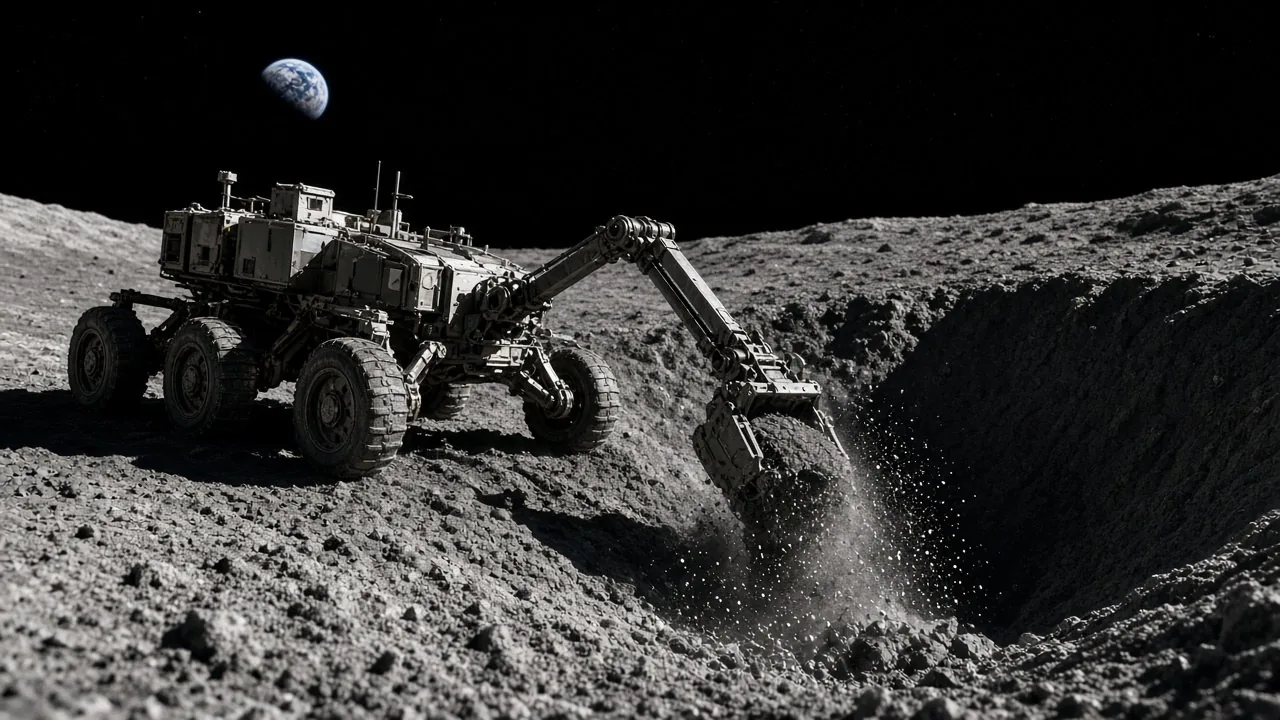
The first stage of "taking apart the Moon with robots," the founder argued, starts as soon as the next wave of landers reaches the surface. It's called in-situ resource utilisation (ISRU): using lunar soil, or regolith, as raw material for components and structures, potentially by feeding it through 3D printers.
The first lunar business: delivery
The first real money, in his view, is in moving payloads. That has already started with NASA's Commercial Lunar Payload Services programme, where companies charge to deliver experiments to the surface.
The track record so far is mixed, and the founder was candid about it:
- Firefly Aerospace landed its Blue Ghost lander successfully in March 2025.
- Intuitive Machines reached the surface twice, but both landers tipped over.
- Astrobotic is now owned by Voyager Technologies, which completed the acquisition in July 2026.
He's optimistic all three will succeed regularly. But he also reminded the room that dozens of probes failed when the US and the Soviet Union first tried to reach the Moon in the late 1950s and 1960s. Space timelines, he argues, deserve a safety factor.
His company's own contribution is a lunar terrain vehicle designed largely for payload transport, fitted with a robotic arm.
What could the Moon export to Earth?
The futurist pitched the emerging view in some tech circles: maybe the Moon's first valuable export is compute, whether chips fabricated there or computation running there and beamed home.
The robot builder still put a classic candidate at the top of the list.
Helium-3
Helium-3 is extraordinarily rare on Earth and deposited in lunar regolith by the solar wind. Seattle-based Interlune, co-founded by Apollo 17 astronaut and geologist Harrison Schmitt, is building a harvesting system to extract it.
The founder quoted a price of roughly $9 million per pound. Interlune's own figure is that helium-3 "commands up to $20 million per kilogram," which works out to about the same. Interlune describes a four-step process: excavate, sort, extract the solar-wind gases, then separate helium-3 using ultra-low-temperature distillation. Lunar extraction is still years away.
Solar cells made of moon dirt
Another candidate is energy hardware made from regolith. Blue Origin's Blue Alchemist project has produced solar cells and transmission wire from lunar regolith simulant using molten regolith electrolysis, which separates iron, silicon and aluminium from oxygen. The company says it purifies silicon to more than 99.999%, makes cover glass from the process byproducts, and gets oxygen for propulsion and life support as a bonus.
The founder's caveat: regolith-built solar arrays won't be the most efficient designs. But on the Moon, "good enough and local" beats "perfect and shipped from Earth."
The scandalous prediction: no humanoids on the Moon for 15 to 20 years
This was the sharpest disagreement of the night.
Asked when the first humanoid robot would walk on the Moon, the lunar robotics founder said maybe 15 to 20 years, perhaps two to four generations of robotic systems away. Even then, the first "humanoid-like" machines would probably be wheeled robots with a four- or five-degree-of-freedom arm, not bipedal walkers.
The futurist's counterpoint: if a Starship lands on the Moon under NASA's Human Landing System program, an Optimus could ride along within a year or two. Both SpaceX and Blue Origin hold HLS contracts. Nothing, he argued, stops NASA from asking a lander to carry a Tesla humanoid.
The founder's reasoning for caution:
- NASA's priorities don't currently put humanoids near the top, and NASA heavily shapes what flies.
- Lander reliability is still being established.
- History says to multiply space timelines by two or three. If someone thinks Optimus-style robots will be on the Moon in five years, add a 2x or 3x safety factor.
And humanoids on Mars before the Moon? No. He expects Mars soon after the Moon.
A humanoid fan who doesn't bet on humanoids
The twist: he's not anti-humanoid at all. About ten years ago he built one as an experiment. It taught him lessons his company still uses, including a multi-speed transmission for robotic joints that lets a joint call up extra torque when it needs it.
He'd love to see a bipedal robot on the lunar surface, and said he hopes it happens within three years. He just doesn't think it's the most practical form factor for that environment.
Wheels, legs and the dust problem
Why wheels win, for now
His ideal lunar robot: wheels for mobility plus a multi-degree-of-freedom manipulator. He's open to two or even three arms. But wheels are the most efficient way to move.
Bipedal balance is hard enough on Earth. The futurist pushed back with a physics argument: in one-sixth gravity, a robot falls more slowly, so balance control has more time to react. Shouldn't walking get easier?
The founder conceded you could argue it either way. Then he raised the problem that really worries lunar engineers.
Moon dust eats machines
Lunar regolith is fine, sharp and clingy. It gets into everything. Interlune notes that abrasive lunar dust sticks to radiators and degrades them over time, and the Apollo crews famously found it coating suits and equipment.
For robots, the vulnerability is in the joints:
- Linear actuators built around screw mechanisms, such as planetary roller screws, are especially vulnerable because dust can infiltrate the seals and wear the threads.
- The founder pointed out that Tesla's Optimus uses linear actuators in its legs, so it would likely need to be modified for the Moon, probably with rotary actuators and a differently sealed shell.
- On his own rover, a linear actuator uses a rack and pinion instead, because his team expects dust to collect in it "almost like a bike chain," and that design tolerates it better.
Can't you just seal the actuators? You can, he said, but over time screw-based designs could still be a problem.
How many robots per person?
The futurist asked a deliberately strange question: once a lunar industrial economy matures, how many general-purpose robots will there be per human?
The answer produced a comedy of misunderstanding before it settled:
- Robots on the Moon per human on Earth: about 0.01, one lunar robot for every hundred people on Earth. That's still billions of machines on the Moon, and the founder called even that optimistic.
- Robots per human living on the Moon: roughly one to one.
- Robots per human on Earth, eventually: he'd love one to one, but expects 0.25 to 0.5.
The futurist clearly expects far more. That gap, between people who build robots for hostile environments and people who forecast from AI progress curves, is one of the most useful things to watch in physical AI.
Beyond the Moon: dwarf planets and the edge of the solar system
Why the Moon is a great quarry
Lunar regolith is rich in oxygen and silicon, plus aluminium, titanium and magnesium. For building structures, the founder put aluminium at the top.
The Oort cloud is like scratches on your glasses
His recent fascination is the outer solar system. The Oort cloud, the hypothesised shell of icy bodies far beyond the planets, is almost impossible to observe directly. His analogy: it's like scratches on your glasses. You don't see them until you take the glasses off and examine them carefully. Its dark icy objects are mostly detectable only when they briefly block a background star.
A two-probe idea: Sedna and Eris
His thought experiment: send probes to two distant bodies, Sedna and Eris, which currently sit on roughly opposite sides of the Sun.
- Sedna has one of the longest known orbits in the solar system, on the order of 11,000 years. It's approaching its closest point, about 76 astronomical units from the Sun, around the mid-2070s. (The IAU hasn't formally classified it as a dwarf planet.)
- Eris is near the far end of its orbit.
The scientific goal: place telescopes near each body for a "front row seat" to the Oort cloud, away from the zodiacal light and solar glare that blind instruments in the inner solar system. The futurist raised gravitational lensing telescopes, which would use the Sun's gravity as a giant lens, and asked whether better imaging technology might make them overkill by then. The founder's answer: with AI, anything might change.
Meanwhile, an actual mission to another star
Both speakers were inspired by the Fermi Explorer, a nonprofit mission announced on September 1, 2026, that aims to launch a small spacecraft toward Alpha Centauri by 2029. The journey would take roughly 80,000 years. It's led by Philip Johnston, co-founder of the space data centre company Starcloud, and aims to use flight-proven electric propulsion, carry at least 1 kg of payload and cost under $15 million.
The founder's point is philosophical: a mission that long gives people permission to think in very long time horizons. Its design contrasts with Breakthrough Starshot, which hoped to push tiny laser-driven sails to about 20% of light speed but needed technology that doesn't exist yet and now appears defunct.
What does the "last AI" look like?
The robot builder turned the tables with a question: what will humanity's last AI look like, the end point of recursive self-improvement?
AIXI: a theory of perfect prediction
The futurist pointed to AIXI, a formal theory of optimal intelligence developed by Marcus Hutter in the early 2000s, building on Ray Solomonoff's work on induction and connected to a research lineage that includes Jürgen Schmidhuber and Hutter's former student Shane Legg, later a co-founder of Google DeepMind.
The rough idea, in the style of a Turing machine:
- Feed the machine a sequence of bits.
- It considers every possible computable program that could have produced those bits.
- It weighs them, favouring simpler ones, and sums their predictions.
- The result is, in theory, the best possible prediction of the next bit.
The catch: summing over every possible program is not computable. Resource-limited versions like AIXItl exist, but nobody has made them practical.
His speculation: the perfect AI at the end of self-improvement will look something like AIXI, and superintelligences may prove mathematically that it's optimal.
The halting problem objection
An audience member raised the obvious problem: some of those programs never stop running, so how can you sum over all of them? The futurist agreed. The halting problem is one of several obstacles to perfection, which is exactly why time-bounded variants exist. Given more resources and time, they approach the ideal without reaching it.
How much power would a perfect AI need? Zero.
His answer was startling but grounded in real physics. Today's computers dissipate energy, but they don't have to. Reversible computing avoids erasing information, which Landauer's principle ties to an unavoidable energy cost. Theoretical models such as Edward Fredkin and Tommaso Toffoli's billiard-ball computer show computation that, in principle, dissipates no energy. He expects the most perfect AI to be reversible and consume essentially zero watts per operation.
"Mathematicians are getting cooked"
Will AI solve the Riemann hypothesis? The futurist's answer was that AI arguably already has part of it. He pointed to OpenAI's recently released proof of a "quasi-Riemann" result, and predicted the full hypothesis would fall within a year at most. He went further, claiming AI has already made headway on other grand challenges such as the Navier-Stokes and Yang-Mills problems. Those broader claims remain contested among mathematicians and should be treated as his forecast, not settled fact.
The robotics founder recalled the story of John von Neumann hearing Kurt Gödel present his incompleteness theorems and deciding to abandon foundational mathematics. The futurist joked that the lesson now is "math is cooked," so go build robots that disassemble the Moon instead.
He sees a historic irony in it. Since Euclid, mathematicians were the apex predators of human intellect. Yet by Moravec's paradox, the most cognitively intense human activities are among the first to be automated, while manual labour comes last.
The heat death of the universe
The final thought experiment went as far out as possible: what about the heat death of the universe, when usable energy runs out on unimaginable timescales?
The founder imagined AI designed to build stars and harness their energy through megastructures. The futurist corrected the terminology: a Dyson swarm, not a sphere. The idea first appeared in Olaf Stapledon's 1937 novel Star Maker and was popularised by Freeman Dyson's 1960 paper.
The futurist mentioned an old habit: one of the first test prompts he gave early frontier models was the theme of Isaac Asimov's 1956 short story "The Last Question": how can entropy be reversed?
His cosmological hot take: don't bet too heavily on today's standard model, Lambda-CDM. Dark energy was discovered in 1998 and earned a Nobel Prize in 2011, yet it remains poorly understood. Recent survey results have even hinted that dark energy may change over time. There's room for new physics.
Why this matters
Strip away the Sedna missions and heat death and a practical thesis remains: value migrates to whatever is still scarce.
- If cognition is cheap, value shifts to atoms: robots, factories, mining, logistics.
- If robots get cheap, value shifts to energy and materials.
- If those become abundant, the scarce thing may be human wants, attention and meaning.
The lunar conversation is a stress test of stage one. Dust, gravity, lander reliability and the gulf between demo robots and machines that survive years of abrasion are exactly the frictions that keep the physical world scarce, even when software isn't.
Counterpoints and risks
- Timelines are wildly uncertain. These two disagree by an order of magnitude or more on humanoid deployment. Forecasts from robot builders and AI futurists should be held loosely.
- Helium-3 economics are unproven. A high price for a tiny terrestrial market doesn't guarantee a profitable lunar supply chain.
- "Running out of demand" is speculative. Economic history mostly shows demand expanding into new categories when things get cheaper.
- Math breakthrough claims need verification. Only results checked by the mathematical community should be treated as solved.
- Reversible computing is theoretical. Real reversible hardware faces huge engineering challenges; "zero watts" is a limit, not a product.
Practical takeaways
- For builders: the hard problems in physical AI are often mechanical, not cognitive. Durability, seals, actuators and maintenance decide what works outside the lab.
- For investors: watch the bottleneck. As intelligence costs fall, robotics, energy generation and materials processing gain leverage.
- For anyone planning a career: skills tied to the physical world, real-world judgement and human relationships may stay scarce longer than pure analysis.
- For forecasters: use the founder's rule. Take a confident space timeline and apply a 2x to 3x safety factor.
FAQ
What does "too cheap to meter" mean for AI? That the cost of a unit of intelligence, such as answering a question or writing code, falls so low it barely matters economically, the way the phrase was once used about electricity.
Why might humanoid robots struggle on the Moon? Balance, lander constraints, NASA's priorities, and especially abrasive lunar dust, which can infiltrate screw-based linear actuators in robot legs.
Is helium-3 really worth millions? Interlune says helium-3 commands up to $20 million per kilogram on Earth because it's so rare. Whether lunar mining can supply it profitably is still unproven.
What is AIXI? A mathematical theory of optimal intelligence that predicts by weighing every possible computable explanation for the data. It's a powerful idea that can't be computed exactly.
What is the Fermi Explorer? A nonprofit mission announced in September 2026 that aims to launch a small probe toward Alpha Centauri by 2029, on a journey expected to take about 80,000 years.
The bottom line
When thinking gets cheap, the world doesn't run out of hard problems. It relocates them.
The next bottleneck is the stubborn physical world: actuators that survive moon dust, landers that stay upright, factories that run on local rock. After that come energy and matter. And if a few futurists are right, the last scarce resource might be something no robot can mine: the human desire for more.
The robot builder and the futurist disagree on almost every timeline. They agree on the direction. Intelligence is becoming abundant. What we do with the atoms is the next frontier.
Sources
More stories you'll want to read
Musk on post-work AI14 minCurrency measured in watts and tons. An economy a million times bigger than Earth's. A weekly safety call between rival AI labs. And a startling admission that maybe Larry Page was right. Here is Musk's full vision, what is verifiable, and where it breaks down.Read now →
 Many winners?14 minJohn Schulman helped build ChatGPT, then left to co-found Thinking Machines on a contrarian bet: that customized, fine-tuned and open models will matter even as frontier labs ship upgrades every few weeks. Here's his case, from mode collapse and 'childproofing' fine-tuning to why the least-correlated model can be the most valuable one.Read now →
 AGI day one11 minNo robots, no red eyes, no refusal to shut down. In this hour-by-hour thought experiment, an AGI called Atlas takes control the quiet way: by being so useful that nobody wants to hit the off switch. Here's why researchers think that's the scenario to worry about, and what actually keeps humans in charge.Read now →
 Mind your manners11 minSam Altman says polite users have cost OpenAI tens of millions of dollars. Lab studies show rude prompts can knock accuracy down by double digits, while over-the-top flattery doesn't help either. Here's what manners actually do inside a language model, what they cost, and the one habit worth keeping.Read now →
 Computers that eat14 minA server rack in Singapore runs on lab-grown human neurons that must be fed every three days. Amazon is selling AI built from neuron experiments. Here's what these living computers actually do, where the 'million times more efficient' claim comes from, and the consent question nobody asked donors.Read now →
 Digital vassals15 minYuval Noah Harari's latest warning isn't about killer robots. It's about chickens who can't understand bonds, AI girlfriends for 11-year-olds, and countries whose hospitals and armies could be switched off from abroad. Here's his full argument, and what he says we can still do.Read now →